
Industries we serve / Cookware
Circle diameter and gauge for pots and pans
The part sets the circle size: circle diameter and gauge for pots and pans come from the part you will make. The diameter comes from matching the circle's area to the part's: an 8 in (203 mm) pot that is 4 in (102 mm) tall needs a theoretical circle of 13.9 in (352 mm), plus the trim your shop cuts off the edge. Gauge and alloy come from the end use: 1050 or 1100 in O temper to draw pots, and 3004 when the base needs more rigidity. Almexa blanks circles from 5.51 to 48 in (140 to 1,219 mm) in diameter and 0.0220 to 0.1575 in (0.56 to 4.0 mm) thick in Cuautitlán Izcalli, Mexico, with a mill test report per lot (technical sheet, September 2026).
Updated 2026-10-22
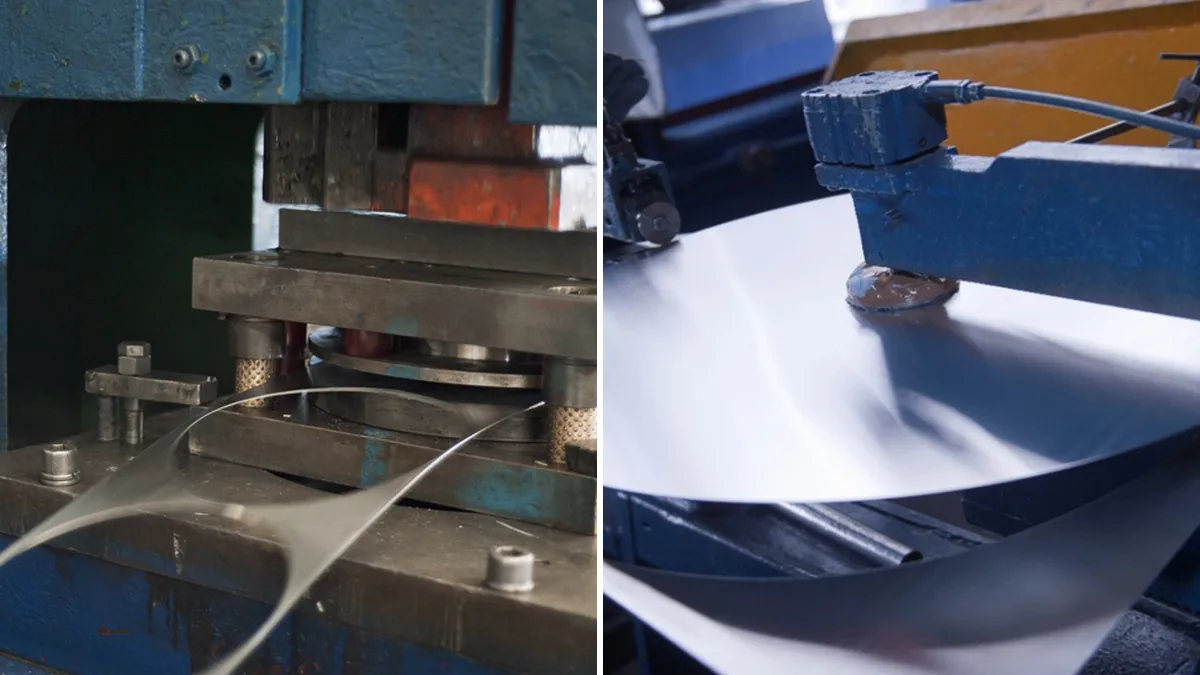
- Circle diameter
- 5.51 to 48 in (140 to 1,219 mm)
- Thickness
- 0.0220 to 0.1575 in (0.56 to 4.0 mm)
- Cookware alloys
- 1050, 1100, 3003, 3004, 3105
- Temper for drawing or spinning
- O (annealed)
A circle for a pot is an aluminum disc blanked from coil and then drawn in a press or spun on a lathe into a pot, a pan or a steamer. Its diameter, gauge and temper decide whether the part comes out complete, without tearing and with a firm base.
What size circle do I need for my pot?
The calculation assumes the thickness does not change: the circle's area must equal the area of the bottom plus the area of the wall. It is the same area-matching method used in conventional spinning (Tapase et al., 2014). For a straight-wall pot of diameter d and height h, the circle diameter is:
D = √(d² + 4 × d × h)
For a hemisphere of diameter d, the circle is d × √2. Add the trim your shop cuts off the edge and, if the part has a flange, its width. The formula assumes a straight wall and a small corner radius: if the wall is sloped, as on many frying pans, work out the part's real area or send the drawing for the plant to check.
Circle, gauge, alloy and temper by part
| Part (example) | Diameter × height | Theoretical circle | Reference gauge | Alloy and temper |
|---|---|---|---|---|
| Saucepan | 6 × 3 in (152 × 76 mm) | 10.4 in (264 mm) | 0.06 to 0.118 in | 1050 or 1100, O |
| Pot | 8 × 4 in (203 × 102 mm) | 13.9 in (352 mm) | 0.06 to 0.118 in | 1050 or 1100, O |
| Pot | 10 × 6 in (254 × 152 mm) | 18.4 in (468 mm) | 0.06 to 0.118 in | 1050 or 1100, O |
| Pressure cooker | 9 × 5 in (229 × 127 mm) | 16.2 in (410 mm) | 0.10 to 0.157 in | 1100 or 3004, O |
| Frying pan | 10 × 2 in (254 × 51 mm) | 13.4 in (341 mm) | 0.08 to 0.157 in | 1100 or 3004, O or H12 |
| Frying pan | 12 × 2 in (305 × 51 mm) | 15.5 in (393 mm) | 0.08 to 0.157 in | 1100 or 3004, O or H12 |
| Steamer | 12 × 12 in (305 × 305 mm) | 26.8 in (682 mm) | 0.04 to 0.08 in | 3004 or 3105, O |
Theoretical circle without trim allowance, from the formula above. Reference gauges, alloys and tempers: Almexa's deep drawing guide, based on its September 2026 technical sheet and plant practice. Your part sets the final gauge: diameter, end use and whether it carries an induction base.
The steamer in the table needs a circle more than twice its diameter. When a part is deeper than its diameter, it is drawn in several steps (Wikipedia, “Deep drawing,” accessed October 22, 2026); that is why O temper, the one that stretches the most, fits it best.
What the pot asks of the circle
- Ductility: the metal has to stretch without breaking. That is why pots are drawn in O temper, the annealed condition; Almexa anneals circles after blanking.
- A firm base: a pan that domes on the stove needs more gauge, or a move from 1100 to 3004 at the same gauge.
- Even thickness across the circle, so the wall and the bottom come out uniform.
- Fine grain and clean metal: coarse grain leaves an orange-peel surface and inclusions break the wall.
- Finish: if the part takes non-stick or paint, temper and coating are chosen together; a baked coating on the wrong temper cracks at the radius.
How Almexa supplies it
As circles blanked at the Cuautitlán Izcalli plant from Almexa's own coil: 5.51 to 48 in (140 to 1,219 mm) in diameter in the 1000 and 3000 series, up to 36 in (914 mm) in the 5000 series, and 0.0220 to 0.1575 in (0.56 to 4.0 mm) thick. They ship in mill finish; non-stick or paint is available on request with the support of Vasconia, Almexa's sister company. Every lot comes with a mill test report with chemistry and mechanical properties. For non-round parts, such as trays and molds, Almexa cuts blanks.
What to send for a quote
- Circle diameter and gauge, or a drawing of the finished part with diameter, height and wall thickness.
- Alloy and temper if you already use them; if not, the type of part and whether it is drawn or spun.
- The coating you will apply and whether the part has food contact.
- Pieces or metric tons per month.
- The gauge and diameter tolerances your process needs.
Product pages, guides and tools
- Aluminum circles size ranges and circles per metric ton
- Aluminum for cookware manufacturers alloys by part and the TIMESA case
- 1100 aluminum the deep drawing alloy
- Aluminum alloy for deep drawing pots and pans why a part tears or warps
- Aluminum circles for spinning circle size for parts spun on a lathe
- Weight calculator weight of circles, sheet and coil
- Quote circles the form already carries the product
Sources: area-matching method, Tapase et al., International Journal of Engineering Development and Research, 2014; Wikipedia, “Deep drawing,” accessed October 22, 2026; size ranges, Almexa technical sheet, September 2026.
Frequently asked questions
What size circle do I need for an 8 in pot?
If the pot is 8 in (203 mm) across and 4 in (102 mm) tall, the theoretical circle is about 13.9 in (352 mm): D = √(d² + 4dh), matching the circle's area to the bottom and the wall. Add the trim your shop cuts off the edge; for another height, change h in the formula.
What gauge circle should I order for a pressure cooker?
As a reference, 0.10 to 0.157 in (2.5 to 4.0 mm) in 1100 or 3004, O temper, per Almexa's deep drawing guide. Your pot's diameter and design set the final gauge. Almexa makes circles from 0.0220 to 0.1575 in (0.56 to 4.0 mm) thick.
O or H14 temper for cookware circles?
O temper, the annealed and softest condition: the circle stretches in the draw or on the spinning lathe without tearing. An H14 arrives work hardened and tears in the wall. Shallow parts that need rigidity, such as frying pans and griddles, use O or H12.
How many 13.9 in circles are in a metric ton?
About 1,870 at 0.080 in (2.03 mm) thick: each circle weighs about 1.18 lb (0.54 kg) at a density of 2.71 g/cm³. The aluminum circles page has the per-ton table from 8 to 20 in.