
Industries we serve / Cookware
Aluminum for trays and molds: 1100 and 3003 blanks
A tray or a non-round mold is drawn from a blank, a flat piece cut to the shape the die needs, not from a circle. Aluminum for trays and molds is ordered as 1100 or 3003 blanks: 1100 in O temper when the part is deep and 3003 when it needs more rigidity. Almexa cuts them from its own coil in Cuautitlán Izcalli, Mexico: 0.0177 to 0.1575 in (0.45 to 4.0 mm) thick and up to 48 in (1,219 mm), square, rectangular or to your drawing, with a mill test report per lot (technical sheet, September 2026).
Updated 2026-10-22
- Alloys
- 1100 and 3003
- Thickness
- 0.0177 to 0.1575 in (0.45 to 4.0 mm)
- Maximum size
- 48 in (1,219 mm); 5000 series, 36 in (914 mm)
- Shape
- Square, rectangular or to drawing
A blank is a flat aluminum piece cut to the shape and size your press takes. The circle is the blank for round parts; trays, molds and pans are made from square or rectangular blanks or from the outline your die calls for.
Which aluminum is used to make trays and molds?
1100 or 3003. 1100 is aluminum of 99.00% minimum purity, the most ductile: it goes in O temper for deep trays and molds or tight corners. 3003 carries 1.0 to 1.5% manganese and is stronger with almost the same formability: it fits when the tray is large or has to hold its shape. Composition: The Aluminum Association, August 2018 revision.
| Part | Process | Alloy and temper | Almexa format |
|---|---|---|---|
| Deep tray or mold with tight corners | Press drawing | 1100-O | Rectangular blank or to drawing |
| Large tray that must hold its shape | Press drawing | 3003-O | Rectangular blank or to drawing |
| Pan with bent sides | Bending or stamping | 3003-H14; O for tight bends | Blank or cut-to-length sheet |
| Round mold or part | Drawing or spinning | 1050 or 1100-O | Circle, 5.51 to 48 in |
Reference tempers: O for deep drawing and tight bends; H14 for stamping and parts that need rigidity (Almexa's 1100 and 3003 alloy pages).
How to size the blank
For a straight-wall tray, the rectangle that contains the blank is the tray length plus twice its height, by its width plus twice its height. Add the flange, if any, and the trim allowance. A 16 × 12 in tray that is 2 in deep needs a blank of about 20 × 16 in before the corners are cut or rounded.
Corners are the hardest-working part of a tray draw: a temper that is too hard or a small die radius shows there first. With your drawing, the plant confirms the blank size and shape.
Blanks per metric ton
Blanks are quoted by the metric ton and used by the piece. This table turns a blank size into pieces per metric ton (1,000 kg, 2,204.6 lb) at 2.71 g/cm³; actual weight varies with the thickness tolerance.
| Blank size | 0.032 in (0.81 mm) | 0.040 in (1.02 mm) | 0.063 in (1.60 mm) |
|---|---|---|---|
| 12 × 16 in (305 × 406 mm) | 3,670 | 2,930 | 1,860 |
| 16 × 20 in (406 × 508 mm) | 2,200 | 1,760 | 1,120 |
| 18 × 24 in (457 × 610 mm) | 1,630 | 1,300 | 830 |
| 20 × 28 in (508 × 711 mm) | 1,260 | 1,010 | 640 |
| 24 × 32 in (610 × 813 mm) | 920 | 730 | 470 |
How Almexa supplies it
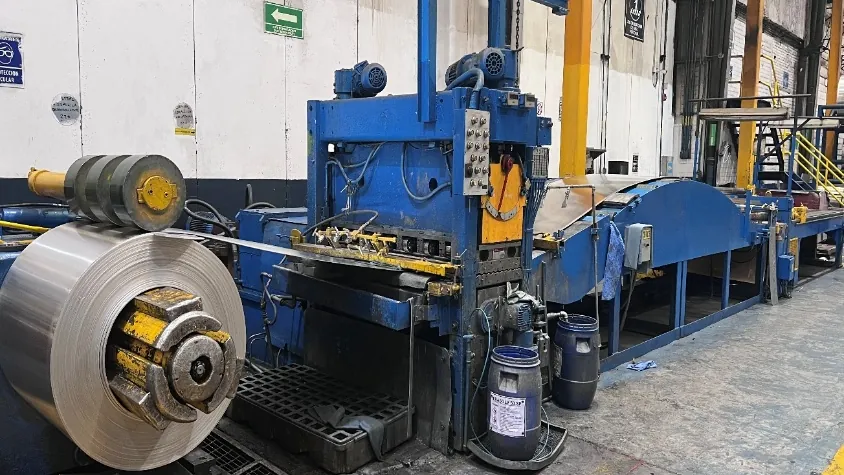
As blanks cut from Almexa's own coil at the Cuautitlán Izcalli plant, which runs 10 stamping presses and cutting lines: square, rectangular or to drawing, 0.0177 to 0.1575 in (0.45 to 4.0 mm) thick and up to 48 in (1,219 mm) in the 1000 and 3000 series. If you cut your own blanks, there is also cut-to-length sheet from 0.0197 to 0.1575 in (0.5 to 4.0 mm), up to 48 × 120 in (1,219 × 3,048 mm). Minimum sizes and cutting tolerances depend on the shape and gauge and are confirmed against your drawing in the quote. Every lot ships with a mill test report with chemistry and mechanical properties.
What to send for a quote
- The drawing or size of the blank, or of the finished tray with its height and corner radius.
- Alloy and temper, or the next process: drawing, bending or stamping.
- Gauge and tolerance.
- Pieces per month.
- The coating you will apply, whether the part has food contact, and packaging and delivery.
Product pages, guides and tools
- Aluminum blanks custom flat shapes
- Aluminum sheet and plate cut-to-length sheet up to 48 × 120 in
- Aluminum for cookware manufacturers
- 1100 aluminum
- 3003 aluminum
- Aluminum alloy for deep drawing pots and pans
- Weight calculator
- Quote blanks the form already carries the product
Sources: composition, The Aluminum Association, International Alloy Designations and Chemical Composition Limits (August 2018 revision); size ranges, Almexa technical sheet, September 2026.
Frequently asked questions
1100 or 3003 for trays?
1100 in O temper if the tray is deep or has tight corners: it is the most ductile. 3003 if the tray is large or has to hold its shape: its manganese makes it stronger with almost the same formability. Almexa cuts blanks in both alloys from 0.0177 to 0.1575 in (0.45 to 4.0 mm).
Can I make disposable foil pans with Almexa aluminum?
No. Disposable pans are made from foil, much thinner than the sheet Almexa makes, which starts at 0.0177 in (0.45 mm). Almexa supplies blanks and sheet for reusable trays, molds and pans.
How do I size the blank for a tray?
For straight walls: tray length plus twice the height, by width plus twice the height, plus the flange and the trim allowance. A 16 × 12 in tray that is 2 in deep needs a blank of about 20 × 16 in before the corners are cut.
What is the largest blank Almexa cuts?
Up to 48 in (1,219 mm) in the 1000 and 3000 series and up to 36 in (914 mm) in the 5000 series, per the September 2026 technical sheet. Minimum sizes and tolerances depend on the shape and gauge and are confirmed against your drawing.