
Blog · Specification
Aluminum Circles for Spinning: Which Alloy, Temper and Blank Size to Order

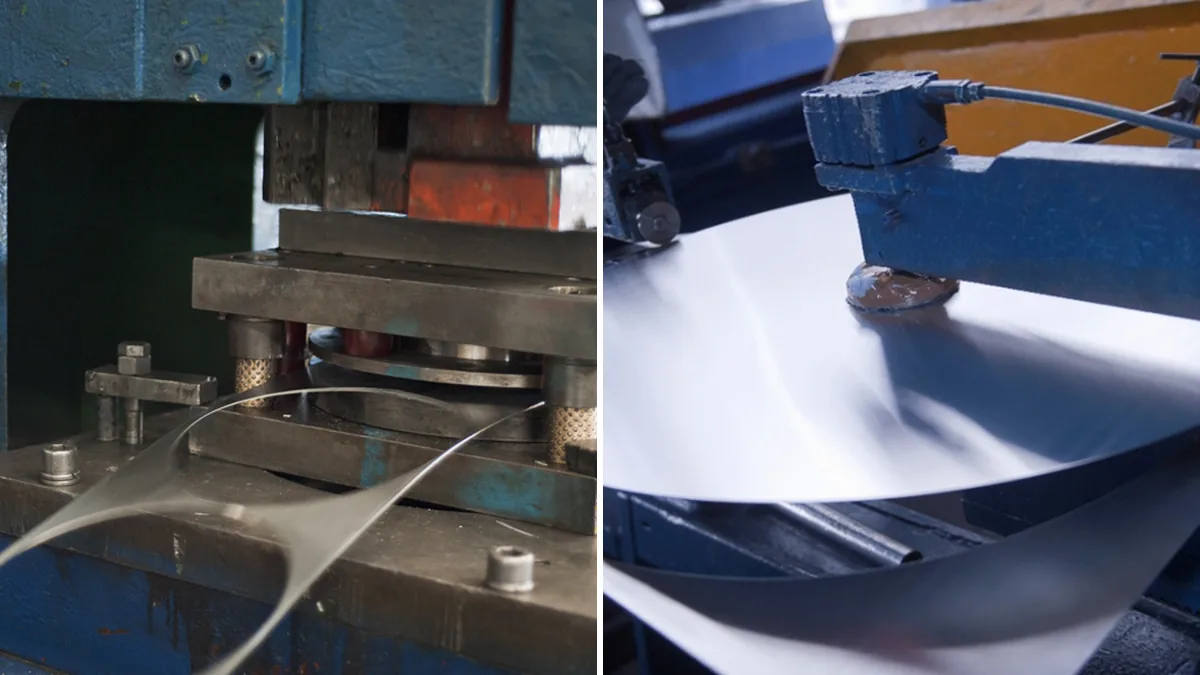
For metal spinning, order aluminum circles in the O temper, fully annealed: 1050 or 1100 for most parts and 3003-O when the part needs more strength. Size the blank by matching areas; for a cup, D = √(d² + 4dh). Almexa blanks circles from 5.51 to 48 in (140 to 1,219 mm) and 0.022 to 0.157 in (0.56 to 4.0 mm) in Cuautitlán Izcalli, Mexico, and anneals them after cutting. Source: Fletter, Stanford, 1995; Tapase et al., IJEDR, 2014; Almexa technical sheet, 2026.
Anyone who spins cookware, lamp shades or reflectors knows the part is decided before the lathe starts: in the circle that arrives at the shop. A circle in the wrong temper cracks halfway through, one that is too small never reaches full height, and one with coarse grain leaves an orange-peel surface. This guide covers which aluminum circle to order for spinning, how to size it, and what to check when a part goes wrong.
Spinning, shear spinning and the names buyers use
Metal spinning is called rechazado in Mexico, entallado in Spain and repoussage in French. In every case a flat circle turns on a lathe together with a form, the mandrel, and a tool pushes the metal until it takes the mandrel's shape. Two variants change the circle you should order (Tapase et al., International Journal of Engineering Development and Research, 2014):
- Conventional spinning: wall thickness barely changes; the circle is laid down over the mandrel. This is how cookware, bells and reflectors are made.
- Shear spinning: the tool thins the wall on purpose. It is common for cones.
What aluminum circle should I order for spinning?
Order the circle in the O temper, fully annealed. It is the softest condition and stretches the most before it breaks; an H temper, strain-hardened, reaches the lathe with part of its formability already used up. Among alloys, the order of ease for spinning is 1100, then 3003, then 5052 (Fletter, metal spinning tutorial, Stanford University, 1995).
| Alloy and temper | When to order it | What to know |
|---|---|---|
| 1050-O or 1100-O | Cookware, bells, reflectors and deep parts | The most ductile; Almexa's recommendation for spinning |
| 3003-O | Parts that need a little more strength | 30% elongation and 16 ksi tensile strength (United Aluminum, 3003 data sheet, accessed October 16, 2026) |
| 3004-O or 3105-O | Thick bottoms or parts that must stay rigid | More strength and less stretch than 1100 |
| 5052-O | Structural parts or parts exposed to impact | Work-hardens the most; harder to form (Stanford, 1995) |
Temper also sets how far you can stretch in one pass. In conventional spinning, the circle can be up to 1.75 times the mandrel diameter if the aluminum is annealed, against 1.67 if it is hard (International Journal of Machine Tools and Manufacture, 2015). For spinning, temper matters as much as alloy: a hard circle reaches the lathe with less stretch left. What each temper means is in the guide to aluminum temper designations.
How to size the blank
In conventional spinning the thickness barely changes, so the blank is sized by matching areas: the area of the circle equals the area of the finished part (Tapase et al., 2014). For a cylindrical cup of diameter d and height h:
D = √(d² + 4 × d × h)
For a hemisphere of diameter d, the circle is d × √2. Add the trim allowance your shop cuts off the rim.
| Part | Dimensions | Theoretical circle diameter |
|---|---|---|
| Cup | d = 6 in, h = 2 in | 9.2 in |
| Pot | d = 8 in, h = 4 in | 13.9 in |
| Large pot | d = 12 in, h = 6 in | 20.8 in |
| Hemisphere | d = 12 in | 17.0 in |
Shear spinning follows a different rule, the sine law: final thickness = circle thickness × sine of the cone half-angle (Tapase et al., 2014). That is why, for cones, the circle thickness is worked back from the wall you need. A single pass can reach about 80% reduction (Ri et al., review of metal spinning, 2020).
| Cone half-angle | Final thickness divided by circle thickness |
|---|---|
| 30° | 0.50 |
| 45° | 0.71 |
| 60° | 0.87 |
Why spun parts crack, wrinkle or show orange peel
- Cracks in the wall: the metal work-hardened beyond what it can take. It happens with H tempers or when a part goes through several passes without an intermediate anneal. 1100 anneals at 644 to 770 °F, 340 to 410 °C (Total Materia, accessed October 16, 2026).
- Flange wrinkles: the rim of the circle compresses faster than the tool supports it. Wrinkling and cracking are the two limits that define how far a part can be spun (Ri et al., 2020).
- Orange peel: a rough surface from coarse grain. In aluminum tests, grains of 37 to 102 microns deformed evenly while grains of 270 to 444 microns concentrated the strain (Cai et al., Materials, 2022).
- Pitting and spin lines: a circle scratched before spinning, or spinning too fast (Gotham Lighting, technical bulletin on reflectors, 2003). The circle should arrive clean and protected.
Before blaming the spinner, check the mill certificate: alloy, temper and mechanical properties.
Should I spin or deep draw?
| Spinning | Deep drawing | |
|---|---|---|
| Tooling | Lathe mandrel, low cost | Press die, high investment |
| Volume | Prototypes, short runs and medium runs | High volumes that pay for the die |
| Cost per part | Higher | Lower |
Source: Tanfield, guide for design engineers, February 16, 2026; The Library of Manufacturing, accessed October 16, 2026.
If you make cookware, you can combine both: deep draw the high-volume part and spin the special sizes or prototypes. Circles for deep drawing are chosen on different criteria, covered in which aluminum alloy to use for deep drawing cookware.
What to send for a quote
- Alloy and temper, for example 1100-O.
- Diameter and thickness, with the tolerance your process needs.
- Quantity in pieces or in pounds or metric tons.
- End use: food contact, coating or anodizing.
Almexa blanks its circles at its plant in Cuautitlán Izcalli, Mexico, from its own coil: diameters from 5.51 to 48 in (140 to 1,219 mm) and thicknesses from 0.022 to 0.157 in (0.56 to 4.0 mm), with the 5000 series up to 36 in (914 mm), in alloys 1050, 1100, 3003, 3004, 3104, 3105, 5005, 5052 and 5754. For spinning we recommend 1050 or 1100 in the O temper; the circles are annealed after cutting and every lot ships with a certificate of chemical analysis and mechanical properties. See sizes on aluminum circles or send your spec for a quote from the mill.
Frequently asked questions
What aluminum is best for metal spinning?
Circles in the O temper, fully annealed: 1050 or 1100 for most parts, such as cookware, bells and reflectors, and 3003-O when the part needs more strength. An H temper arrives work-hardened and cracks sooner. The order of ease for spinning is 1100, 3003 and 5052 (Stanford, 1995).
How do I calculate the blank size for a spun part?
Match the area of the circle to the area of the part. For a cup of diameter d and height h, D = √(d² + 4dh): a pot 8 in across and 4 in tall needs a circle of about 13.9 in, plus the trim allowance your shop cuts off the rim.
Why does aluminum crack during spinning?
Because the metal work-hardened beyond what it can take: an H temper from the start, several passes without an intermediate anneal, or too much reduction in one pass. 1100 anneals at 644 to 770 °F. Scratches on the circle also start pitting.
Does Almexa sell aluminum circles for spinning?
Yes. Almexa blanks circles at its plant in Cuautitlán Izcalli, Mexico, from 5.51 to 48 in in diameter and 0.022 to 0.157 in thick; for spinning it recommends 1050 or 1100 in the O temper, annealed after cutting, with a certificate of analysis for every lot.

Leads Almexa Aluminio, Mexico's aluminum rolling mill. Writes about alloys, process, pricing and supply for industrial buyers in North America. LinkedIn