
Blog · Quality
Aluminum for food contact: alloys, standards and what to order for cookware

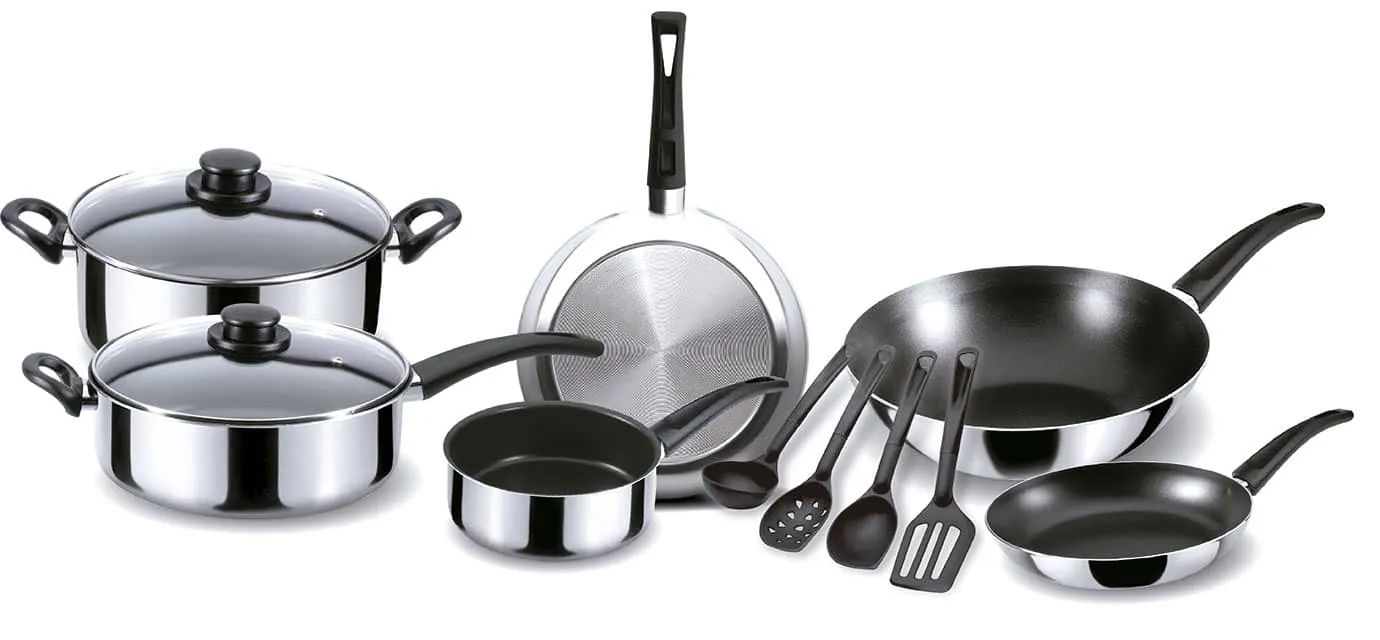
Cookware uses 1000 and 3000 series aluminum: 1050 or 1100 in O temper for drawing and spinning, and 3003, 3004 or 3105 when the part needs stiffness. It is chosen because it conducts heat: 1100 conducts about 14 times more than 304 stainless steel, and the specific heat of aluminum is 0.897 J/(g·K), or 0.214 BTU/(lb·°F). In Europe, EN 602 sets its composition for food contact and the Council of Europe recommends a release limit of 5 mg of aluminum per kg of food; BfR and Health Canada advise against preparing or storing acidic or salty foods in uncoated aluminum. In the US, the FDA holds sellers responsible for cookware safety and has warned about imported aluminum alloy cookware that can leach lead. Almexa makes circles from 0.0220 to 0.1575 in (0.56 to 4.0 mm) in Cuautitlán Izcalli, Mexico, with a mill test report per lot. Sources: NIST; EDQM, 2021; BfR, 2020; Health Canada, 2025; FDA, 2024; Almexa fact sheet, 2026.
An aluminum pot goes through three departments before it reaches a kitchen: purchasing picks the circle, production draws it and quality signs off that the part is fit for food. This guide puts together what all three need in a cookware plant: why aluminum is used, which alloys go into pots and pans, what standards and health agencies say about aluminum that moves into food, and what to ask your circle or sheet supplier. It applies to household and commercial aluminum cookware alike.
Why is aluminum used in cookware?
Health Canada sums it up in three reasons: aluminum cookware is lightweight, conducts heat well and is fairly inexpensive (The safe use of cookware and bakeware, modified September 8, 2025). The second reason is measured as thermal conductivity, which tells how fast heat spreads through the metal: with a high value, heat from the burner spreads across the whole base instead of building up in one spot.
| Material (80 °F, 27 °C) | W/m·K | BTU/(h·ft·°F) |
|---|---|---|
| Pure aluminum | 237 | 137 |
| 1100 aluminum | 212 | 122 |
| 3003 aluminum, F temper | 178 | 103 |
| Pure iron | 80 | 46 |
| 304 stainless steel | 15 | 8.8 |
Source: pure aluminum and iron, Ho, Powell and Liley, "Thermal Conductivity of the Elements," Journal of Physical and Chemical Reference Data, NIST, 1972; 1100 aluminum, 3003 aluminum and 304 stainless steel, calculated at 300 K with NIST material property equations. Cast iron in a skillet has a different composition and different values.
1100 aluminum conducts heat about 14 times better than 304 stainless steel and more than 2.5 times better than pure iron. The alloy matters too: 1100, at 99% aluminum, conducts more than 3003, which carries 1.0 to 1.5% manganese. When a part needs stiffness and moves to the 3000 series, it gains strength and gives up some conductivity.
What is the specific heat of aluminum?
The specific heat of aluminum is 0.897 J/(g·K) at 77 °F (25 °C): 897 joules per kilogram per degree, or 0.214 BTU/(lb·°F). Per mole, its heat capacity is 24.2 J/(mol·K). Source: NIST-JANAF thermochemical tables (Chase, 1998), published in the NIST Chemistry WebBook.
| Material (77 °F, 25 °C) | J/(g·K) | BTU/(lb·°F) |
|---|---|---|
| Aluminum | 0.897 | 0.214 |
| 304 stainless steel | 0.470 | 0.112 |
| Iron | 0.449 | 0.107 |
Source: aluminum and iron, NIST-JANAF (Chase, 1998); 304 stainless steel, NIST material property equation at 298 K. In BTU/(lb·°F) the value equals cal/(g·°C), with 1 cal = 4.184 J.
Specific heat and heat capacity are not the same thing. Specific heat belongs to the material, per gram or per pound. Heat capacity belongs to the part: its mass times its specific heat. A 2.2 lb (1 kg) aluminum pot needs about 72 kJ (68 BTU) to go from 68 to 212 °F (20 to 100 °C); a 304 stainless steel pot of the same weight needs about 38 kJ (36 BTU). At equal weight, aluminum stores almost twice as much heat as stainless steel or iron.
Which aluminum alloy is food safe?
There is no alloy called "food grade." In Europe, the reference for composition is EN 602: it sets the maximum content of alloying elements and impurities in wrought aluminum, such as rolled sheet and circles, used to make articles that touch food, and includes rules to demonstrate conformity. The current edition dates from July 2026 and replaces the 2004 edition (EVS, the Estonian standards body, EN 602:2026 record). The standard is sold, so its list of limits is not reproduced here.
For drawn or spun cookware, Almexa's guides recommend 1000 and 3000 series alloys:
| Alloy | Composition | Use in cookware |
|---|---|---|
| 1050 | 99.50% aluminum minimum | Deep drawing and spinning, in O temper |
| 1100 | 99.00% aluminum minimum, 0.05 to 0.20% copper | Pots, steamers and spun parts, in O temper |
| 3003 | 1.0 to 1.5% manganese, 0.05 to 0.20% copper | Blanks for trays and molds |
| 3004 | 1.0 to 1.5% manganese, 0.8 to 1.3% magnesium | Thick bases, pans and pressure cookers |
| 3105 | 0.30 to 0.8% manganese, 0.20 to 0.8% magnesium | Large steamers and parts that must stay rigid |
Source: composition, The Aluminum Association, Teal Sheets, revised August 2018; uses, Almexa's deep drawing and spinning guides and its September 2026 fact sheet. Almexa makes all five, plus 1350, 3104, 5005, 5052 and 5754.
Lead deserves its own line on the purchase order. In 1050, 1100, 3003, 3004 and 3105, the Aluminum Association registration sets no specific limit for it: lead falls under "others," with a maximum of 0.05% each (0.03% in 1050). The same publication notes that the producer may analyze those trace elements but is not required to (Teal Sheets, note 13). If your standard or your customer caps lead or cadmium, write it on the purchase order and ask for it on the lot's mill test report.
This is not a theoretical concern. In December 2024 the US FDA told retailers and distributors that some imported cookware made from aluminum, brass and aluminum alloys known as Hindalium or Indalium showed the potential to leach lead when tested under conditions that mimic use with food (FDA letter of December 12, 2024); it updated its consumer alert in September 2025.
What do health agencies say about aluminum moving into food?
Aluminum in the food industry shows up in pots, pans and foil (EFSA, 2008), and also in beverage cans, yogurt cup lids and juice containers, which are coated on the inside so aluminum does not transfer to the food (BfR, 2020). This is what health agencies publish about that transfer:
- EFSA, the European Food Safety Authority, set a tolerable weekly intake of 1 mg of aluminum per kg of body weight in 2008. It estimated that adults take in 0.2 to 1.5 mg per kg per week on average from their diet, with cereals and cereal products, vegetables, beverages such as tea and cocoa, and some infant formulae as the main contributors. Pots, pans and foil also contribute, but the studies only allowed the total to be measured, not each source (EFSA, July 15, 2008).
- The Council of Europe adopted Resolution CM/Res(2013)9 on metals and alloys in food contact on June 11, 2013. Its technical guide, managed by the EDQM, sets a specific release limit of 5 mg of aluminum per kg of food (EDQM FAQ, updated September 22, 2021). The European Union has no specific measure for metals beyond the general Regulation (EC) No 1935/2004, and most European national authorities recognize the guide (EDQM, same source). Belgium, the Netherlands and Luxembourg seek to apply the resolution jointly (Benelux Decision M (2022) 12, cited in notification 2025/0180/LU to the European Commission, March 28, 2025).
- Germany's Federal Institute for Risk Assessment (BfR) explains that aluminum dissolves under the influence of acids or salt. Asked about aluminum pots and pressure cookers, it says they can still be used if they are coated; if not, salty or acidic foods such as apple purée, tomato purée, rhubarb or salted herring should not be prepared or stored in them (BfR aluminum FAQ, July 20, 2020). In a test with uncoated aluminum trays, release into acidic foods kept warm for two hours exceeded the 5 mg/kg limit, which the BfR says was set on the basis of what is technically feasible (BfR Opinion No 007/2017, May 29, 2017).
- Health Canada advises against using aluminum cookware for foods high in acid or salt and against cooking or storing food in it for long periods. It says anodized aluminum conducts heat as well as ordinary aluminum, has a hard surface and reduces the transfer of aluminum into foods, particularly acidic foods like tomatoes and rhubarb; it advises against using scratched or worn anodized cookware (Health Canada, September 8, 2025).
BfR and Health Canada agree on the practical point: uncoated aluminum is not for cooking or storing acidic or salty foods for long, and coating or anodizing reduces aluminum transfer. This summary repeats what these agencies publish; it is not medical advice.
Which rules apply in the United States and Mexico?
In the United States, we found no section of Title 21 of the Code of Federal Regulations specific to aluminum cookware (search for "cookware" in the eCFR, October 25, 2026). The FDA reminds retailers and distributors that they are responsible for ensuring that the cookware they sell for food contact is safe for its intended use and complies with all FDA regulations; for lead, it uses a leach test of a 2-hour boil followed by holding for a total of 24 hours (FDA letter of December 12, 2024).
In Mexico, NOM-225-SCFI-2019 covers non-stick coated cookware sold in the country. It accepts aluminum, steel, stainless steel, iron, ceramic and glass as base materials, and caps lead at 0.05% and cadmium at 0.01% in both the coating and the substrate (Diario Oficial de la Federación, March 11, 2020; in force since September 7, 2020). If your circle will carry non-stick for the Mexican market, the NOM-225 lead limit also applies to the aluminum base. Household pressure cookers also fall under NOM-054-SCFI-1998, a safety standard. In the Mexican Standards Catalog of the Ministry of Economy we found no NOM specific to uncoated aluminum cookware in food contact; the voluntary NMX-W-152-SCFI-2005 covers non-stick coated aluminum cookware (search of October 25, 2026).
What to ask your circle or sheet supplier for food contact
- Alloy and temper in writing, for example 1100-O. What each temper means is in the guide to aluminum temper designations.
- A mill test report for every lot with the measured chemical composition and, if your standard requires it, lead and cadmium.
- The food safety system certificate. FSSC 22000 is a certification scheme for food safety management systems based on ISO 22000 and recognized by the Global Food Safety Initiative (Foundation FSSC). Ask for the copy and check that its scope covers the product you buy.
- The finish: mill finish, non-stick, paint or anodizing, and whether the part will have direct food contact. If the coating goes on before drawing, temper and coating are chosen together.
- Thickness, diameter and the tolerance your process needs. As a reference, 0.06 to 0.118 in (1.5 to 3.0 mm) for pots, 0.10 to 0.157 in (2.5 to 4.0 mm) for pressure cookers, 0.08 to 0.157 in (2.0 to 4.0 mm) for pans and 0.04 to 0.08 in (1.0 to 2.0 mm) for steamers; your part sets the final gauge. How to size the circle is in circles for pots and pans.
- If you sell into Europe, the EN 602 edition the composition is declared against and the conformity documents your customer requires.
Almexa circles and sheet for cookware
Almexa stamps aluminum circles at its plant in Cuautitlán Izcalli, State of Mexico, from 5.51 to 48 in (140 to 1,219 mm) in diameter (up to 36 in, 914 mm, in the 5000 series) and from 0.0220 to 0.1575 in (0.56 to 4.0 mm) thick, and makes aluminum sheet from 0.0197 to 0.1575 in (0.5 to 4.0 mm) and blanks for trays and molds. Circles ship in mill finish and, on request, with non-stick coating or paint, with support from Vasconia, Almexa's sister company. Every lot carries a mill test report with chemical analysis and mechanical properties. The plant's certifications, who issues them and how they are shared are on the certifications page. One manufacturer making pots and steamers with its circles is Aluminio TIMESA. If a part tears or warps when drawn, see which aluminum alloy to use for deep drawing.
Send your specification for a quote from the mill: alloy, temper, diameter or size, thickness, finish, whether there is food contact and pieces per month.
Sources
All accessed October 25, 2026.
- Health Canada, "The safe use of cookware and bakeware", modified September 8, 2025: why aluminum is used, acidic or salty foods and anodized aluminum.
- Ho, Powell and Liley, "Thermal Conductivity of the Elements," Journal of Physical and Chemical Reference Data 1, 279, 1972: thermal conductivity of pure aluminum and iron at 300 K.
- NIST material properties for 1100 aluminum, 3003-F aluminum and 304 stainless steel: thermal conductivity and specific heat equations, evaluated at 298 and 300 K.
- NIST Chemistry WebBook, NIST-JANAF data for aluminum and iron (Chase, 1998): specific heat at 25 °C.
- The Aluminum Association, "International Alloy Designations and Chemical Composition Limits for Wrought Aluminum and Wrought Aluminum Alloys" (Teal Sheets), August 2018: composition of 1050, 1100, 3003, 3004 and 3105 and note 13 on other elements.
- EVS, EN 602:2026 record: title, scope and current edition of the standard.
- EFSA, "EFSA advises on the safety of aluminium in food," July 15, 2008: tolerable weekly intake, dietary exposure and sources.
- EDQM FAQ on metals and alloys in food contact, updated September 22, 2021: Resolution CM/Res(2013)9, technical guide, 5 mg/kg limit and Regulation (EC) No 1935/2004.
- European Commission, notification 2025/0180/LU, March 28, 2025: date of the resolution and Benelux Decision M (2022) 12.
- BfR, FAQs about aluminium in food and products intended for consumers, July 20, 2020: coated and uncoated pots, acidic or salty foods and packaging coated on the inside.
- BfR Opinion No 007/2017, May 29, 2017: uncoated trays and the basis of the 5 mg/kg limit.
- Diario Oficial de la Federación, NOM-225-SCFI-2019, March 11, 2020: base materials and lead and cadmium limits.
- Mexican Standards Catalog, records for NOM-225-SCFI-2019 and NOM-054-SCFI-1998 and search for "utensilios": status and existing standards.
- eCFR, search for "cookware" in Title 21: no results.
- FDA, letter to retailers and distributors of cookware, December 12, 2024 and alert updated in September 2025: lead in imported cookware, leach test and seller responsibility.
- Foundation FSSC, FSSC 22000: what the certification scheme is.
Frequently asked questions
Which aluminum alloy is food safe?
For drawn or spun cookware, Almexa recommends 1000 and 3000 series alloys: 1050, 1100, 3003, 3004 and 3105. In Europe, EN 602 sets the maximum alloying elements and impurities for aluminum in food contact. Order alloy and temper in writing and ask for the lot's mill test report; if your customer caps lead, have it reported.
What is the specific heat of aluminum?
0.897 J/(g·K) at 77 °F (25 °C), or 897 J/(kg·K), which equals 0.214 BTU/(lb·°F), per the NIST-JANAF tables. That is almost twice the value of 304 stainless steel (0.470 J/(g·K)) and iron (0.449 J/(g·K)).
What is the heat capacity of aluminum?
Per mole, 24.2 J/(mol·K) at 77 °F (25 °C) (NIST-JANAF). The heat capacity of a part is its mass times its specific heat: a 2.2 lb (1 kg) aluminum pot needs about 72 kJ (68 BTU) to go from 68 to 212 °F.
Is it safe to cook in aluminum pots?
What health agencies publish are use precautions. Germany's BfR says coated aluminum pots can be used and that salty or acidic foods should not be prepared or stored in uncoated ones; Health Canada advises against cooking or storing food in aluminum cookware for long periods and notes that anodizing reduces aluminum transfer. This is not medical advice.
Which standards apply to aluminum in food contact?
In Europe, EN 602 for the composition of wrought aluminum and Council of Europe Resolution CM/Res(2013)9, with a release limit of 5 mg of aluminum per kg of food. In the US, we found no Title 21 CFR section specific to aluminum cookware; the FDA holds sellers responsible for cookware being safe. In Mexico, NOM-225-SCFI-2019 covers non-stick cookware and caps lead at 0.05% and cadmium at 0.01%.
Why is aluminum used in cookware?
Because it is lightweight, conducts heat well and is fairly inexpensive (Health Canada, 2025). 1100 aluminum conducts about 212 W/m·K at 80 °F, against about 15 for 304 stainless steel and 80 for pure iron (NIST), so it spreads burner heat across the base.
What should I ask an aluminum circle supplier for food contact?
Alloy and temper in writing, a mill test report per lot with chemical composition, the food safety system certificate such as FSSC 22000, the finish and whether the part has food contact, and thickness, diameter and tolerance. Almexa ships a mill test report with every lot; its certifications are listed on the certifications page at almexa.com.mx.

Leads Almexa Aluminio, Mexico's aluminum rolling mill. Writes about alloys, process, pricing and supply for industrial buyers in North America. LinkedIn