
Blog · Specification
Aluminum coil slitting: how slit coil is made, which tolerances to ask for and how to inspect it

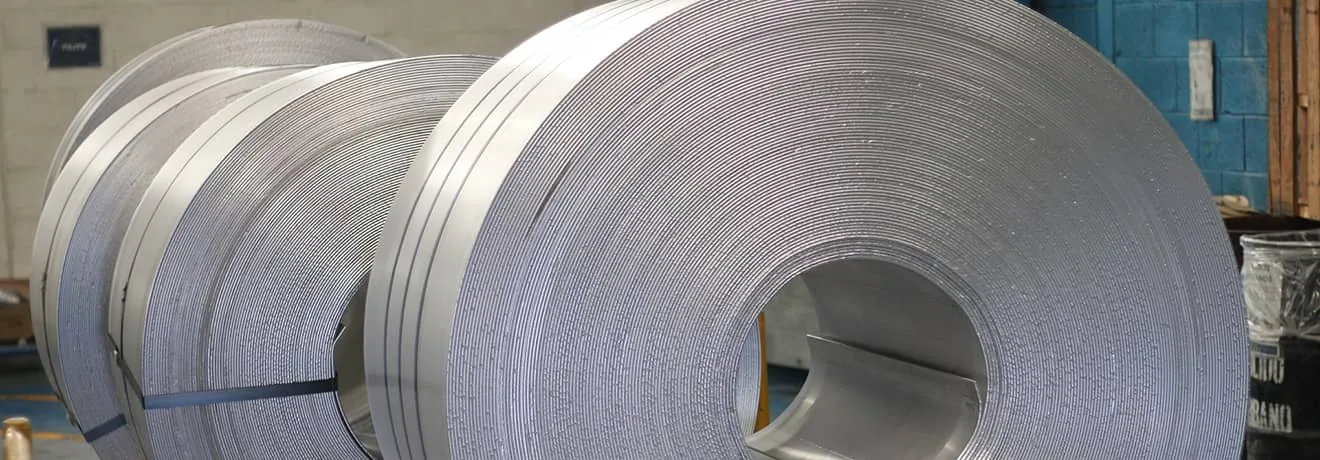
Coil slitting turns a wide aluminum coil into several narrow coils, called slit coil or strip: the master coil runs off an uncoiler, through pairs of rotary knives, and the strands are rewound with separators and tension. Quality comes down to four checks: width tolerance, edge burr, camber and a tight, even wind with no telescoping. For reference, the ANSI H35.2 tables published by United Aluminum give slit width tolerances of ±0.010 in to ±1/16 in (±0.25 to ±1.59 mm) depending on width and gauge; the tolerance for your order is confirmed in writing on the quote. Almexa runs 3 slitting lines and supplies coil 6.30 to 48 in (160 to 1,219 mm) wide in the 1000 and 3000 series and 6.30 to 36 in (160 to 914 mm) in the 5000 series, on a 20 in (508 mm) ID. Sources: United Aluminum, ANSI H35.2 tables, accessed October 28, 2026; Almexa data sheet, October 2026.
Few roll formers or progressive dies take the full width of a mill coil. The coil is cut lengthwise into narrower strands and each strand is rewound: that is slit coil, also sold as aluminum strip. In British spelling the search is aluminium coil slitting; in Mexico the product is called fleje, and in French-speaking Canada, bandes refendues.
How to pick the mill width and work out edge scrap is covered in aluminum coil widths. This guide is about the slitting itself: how it works, which defects it can leave, what to put in writing and how to inspect slit coil at receiving.
How a slitting line works
- Uncoiler (payoff). Takes the master coil on its inside diameter and unwinds it against a brake that keeps the sheet under tension.
- Slitter head. Two arbors, one above the other, carry rotary knives in pairs. Each pair cuts like scissors: the top knife overlaps the bottom one slightly, with a small side clearance between them. Spacers between the knives set the width of each strand.
- Edge trim. Both edges of the master coil are trimmed off as scrap, so every strand has a slit edge.
- Separators and tension stand. Before the recoiler, separator discs keep the strands apart so they do not interleave, and a tension stand pulls them evenly.
- Recoiler. Winds all strands at once on the same mandrel. Each coil is then banded, tagged and packed.
Knife position sets the width; knife sharpness and setup set the edge.
The edge: burr and other defects
Burr is the small lip of metal left on the slit edge. It shows up when knife clearance does not match the gauge, when knives get dull or when the overlap is too deep. A study on 0.04 and 0.08 in (1 and 2 mm) 5754 aluminum found that clearance accounted for 76% of burr formation and sheet thickness for 23% (Çavuşoğlu and Gürün, Transactions of FAMENA, 2017). The study is on blanking, but the principle holds for rotary knives: setup rules.
Burr cuts hands, scores dies and roll-former rolls, and on electrical or painted parts it can be grounds for rejection. If your process is sensitive, put a maximum burr height and the acceptable side on the RFQ.
Other edge defects to check:
- Edge wave: the edge ends up longer than the center of the strand and ripples when laid flat.
- Knife marks: lengthwise scratches next to the cut.
- Slivers: thin threads of metal that peel off the edge and can get wound into the coil.
Width tolerance
The tolerance standard for aluminum mill products is ANSI H35.2, "Dimensional Tolerances for Aluminum Mill Products," from the Aluminum Association; the current edition is 2024. Its tables are not free to read. United Aluminum, a US strip producer, publishes these slit coil values from ANSI H35.2 in its technical manual:
| Specified width | Gauge 0.006 to 0.125 in (0.15 to 3.18 mm) | Gauge 0.126 to 0.186 in (3.20 to 4.72 mm) |
|---|---|---|
| Up through 6 in (152 mm) | ±0.010 in (0.25 mm) | ±0.012 in (0.30 mm) |
| Over 6 through 12 in (152 to 305 mm) | ±1/64 in (0.40 mm) | ±1/32 in (0.79 mm) |
| Over 12 through 24 in (305 to 610 mm) | ±1/32 in (0.79 mm) | ±1/32 in (0.79 mm) |
| Over 24 through 48 in (610 to 1,219 mm) | ±3/64 in (1.19 mm) | ±1/16 in (1.59 mm) |
Source: United Aluminum technical manual, page 5, accessed October 28, 2026; millimeters converted from the inches in the table. Always check against the edition of the standard cited on your purchase order.
This table is a public reference, not an Almexa commitment: the tolerance for your order is confirmed in writing on the quote. If your die needs a tighter tolerance, put it on the RFQ from the start.
Camber
Camber is how far the edge of the strand departs from a straight line: laid on the floor, the strand bows to one side. It comes from residual stress in the master coil, a thickness difference from one side to the other (crown or wedge) or misaligned knives. On a roll former, a cambered strand rides against one guide; in a progressive die, the holes walk.
It is measured with a straightedge or a taut string: the maximum gap between edge and line over a given length. The table United Aluminum publishes from ANSI H35.2 uses a 6 ft (1.83 m) length:
| Strand width | Gauge 0.006 to 0.064 in (0.15 to 1.63 mm) | Gauge 0.065 to 0.125 in (1.65 to 3.18 mm) |
|---|---|---|
| 1/2 through 1 in (12.7 to 25.4 mm) | 3/4 in (19.1 mm) | Not listed |
| Over 1 through 2 in (25.4 to 50.8 mm) | 9/16 in (14.3 mm) | Not listed |
| Over 2 through 4 in (50.8 to 101.6 mm) | 3/8 in (9.5 mm) | 3/8 in (9.5 mm) |
| Over 4 through 10 in (101.6 to 254 mm) | 1/4 in (6.4 mm) | 1/4 in (6.4 mm) |
| Over 10 in (254 mm) | 3/16 in (4.8 mm) | 3/16 in (4.8 mm) |
Narrow strands are allowed more camber. The table gives no value above 0.125 in gauge: if your process needs one, it is agreed on the quote.
Telescoping and wind quality
A telescoped coil has its wraps shifted to one side, like a spyglass or a cone. Causes: uneven rewind tension, an off-center core or uneven gauge. A coil like that gets edge damage when handled, is hard to load on the uncoiler and can shed wraps. At receiving, both coil faces should be flat and the wraps tight. How coil should be blocked and secured so it arrives that way is in how to ship aluminum coil, sheet and circles without damage.
ID, OD and weight per inch of width
Almexa coil has a 20 in (508 mm) ID and an OD of 39 to 46 in (990.6 to 1,168 mm), per its data sheet. Strands slit from the same master coil share its OD, so each strand's weight depends on its width. US buyers usually talk in PIW, pounds per inch of width.
Weight follows from coil geometry: π/4 times the difference of the squares of OD and ID, times width, times density. With a 20 in ID and 2.71 g/cm³, the density the site's coil weight calculator uses:
| OD | Weight per inch of width (PIW) | 12 in wide strand |
|---|---|---|
| 39 in (990.6 mm) | 86 lb (39 kg) | 1,034 lb (469 kg) |
| 46 in (1,168 mm) | 132 lb (60 kg) | 1,582 lb (718 kg) |
Our own calculation; the actual weight of each coil is on its tag. 5052 weighs about 1% less, at 2.68 g/cm³ (The Aluminum Association). If your uncoiler takes less weight or a smaller OD, say so on the RFQ.
What to specify for slit coil
- Final width of each strand and its tolerance.
- Gauge, alloy and temper.
- ID, maximum OD and maximum coil weight (or PIW) your uncoiler takes.
- Maximum burr height and side, if your process is sensitive.
- Maximum camber, if you feed a progressive die or a long roll former.
- Packaging: eye to sky or eye horizontal, and protection between coils.
- Pounds or tons per month and what the part is.
With the final width and the mill width, the slitting calculator shows how many strands you get and how much edge scrap is left. The full spec, from alloy to receiving, is in how to specify and buy aluminum sheet and coil.
How to inspect slit coil at receiving
- Tag against PO: alloy, temper, gauge, width, weight and lot.
- Width: with calipers at the coil tail and at several wraps as it pays off.
- Gauge: with a micrometer at the center and near both edges.
- Burr: measure thickness at the edge and subtract the sheet gauge; check both edges of every strand.
- Camber: lay 6 ft of strand on a flat table and measure the largest gap to a straightedge or string.
- Wind: flat coil faces, no popped wraps, no dented edges.
- Mill test report: the master coil's lot MTR travels with the slit coil; how to read it is in how to read an aluminum mill test report.
If something is off, hold the coil unprocessed, photograph the tag and the defect, and notify in writing.
How Almexa works
Almexa casts, rolls and slits in Cuautitlán Izcalli, State of Mexico, with 3 slitting lines. It supplies coil 6.30 to 48 in (160 to 1,219 mm) wide in the 1000 and 3000 series and 6.30 to 36 in (160 to 914 mm) in the 5000 series, 0.0177 to 0.148 in (0.45 to 3.76 mm) thick (from 0.0197 in, 0.50 mm, in the 5000 series), on a 20 in (508 mm) ID with a 39 to 46 in OD. Tolerances follow Aluminum Association standards; the minimum strip width and the slitting tolerance depend on gauge and alloy and are confirmed in writing on the quote. Slit coil comes off coil Almexa rolls itself and ships with the lot's mill test report. See aluminum strip and aluminum coil; if your part comes off a press stroke, see also aluminum blanks.
Send your specification for a quote from the mill: final width, gauge, alloy, temper and pounds per month.
Sources
All accessed October 28, 2026.
- United Aluminum, "Aluminum Sheet & Coil Published Dimensional Tolerances," technical manual, page 5: slit coil width and camber tolerances from ANSI H35.2.
- The Aluminum Association, ANSI H35.2, "Dimensional Tolerances for Aluminum Mill Products," 2024: tolerance standard.
- Çavuşoğlu and Gürün, "The Relationship of Burr Height and Blanking Force with Clearance in the Blanking Process of AA5754 Aluminium Alloy," Transactions of FAMENA, vol. 41, no. 1, 2017: clearance and burr.
- The Aluminum Association, International Alloy Designations and Chemical Composition Limits, August 2018 revision: 5052 density.
- Almexa data sheet, October 2026: slitting lines, widths, gauges and coil diameters.
Frequently asked questions
What is aluminum coil slitting?
It is the process that cuts a wide aluminum coil lengthwise into several narrow coils, called slit coil or strip. The master coil pays off an uncoiler, runs through pairs of rotary knives, and the strands are rewound with separators and tension.
What is the width tolerance for slit aluminum coil?
For reference, the ANSI H35.2 tables published by United Aluminum give ±0.010 in up through 6 in wide and ±3/64 in over 24 through 48 in, for gauges of 0.006 to 0.125 in. The tolerance for your order is confirmed in writing on the quote.
What is camber in slit coil?
It is how far the edge of the strand departs from a straight line. It is measured with a straightedge or taut string over a set length; the ANSI H35.2 table published by United Aluminum uses 6 ft and allows more camber on narrow strands.
What causes burr on slit aluminum?
Knife clearance that does not match the gauge, dull knives or too much knife overlap. If your process is burr-sensitive, put the maximum burr height and the acceptable side on the RFQ.
What is telescoping in a coil?
It is when the wraps shift to one side and the coil takes a cone shape. It comes from uneven rewind tension, an off-center core or uneven gauge, and it leads to edge damage and trouble loading the uncoiler.
How much does slit aluminum coil weigh per inch of width?
It depends on OD. With a 20 in ID and a density of 2.71 g/cm³, aluminum coil weighs about 86 lb per inch of width at a 39 in OD and 132 lb at 46 in: a 12 in strand weighs about 1,034 to 1,582 lb.
What widths does Almexa slit?
Almexa runs 3 slitting lines and supplies coil 6.30 to 48 in (160 to 1,219 mm) wide in the 1000 and 3000 series and 6.30 to 36 in (160 to 914 mm) in the 5000 series. Minimum strip width and tolerance depend on gauge and alloy and are confirmed on the quote.

Leads Almexa Aluminio, Mexico's aluminum rolling mill. Writes about alloys, process, pricing and supply for industrial buyers in North America. LinkedIn