
Blog · Specification
How to specify and buy aluminum sheet and coil: a guide from spec to receiving

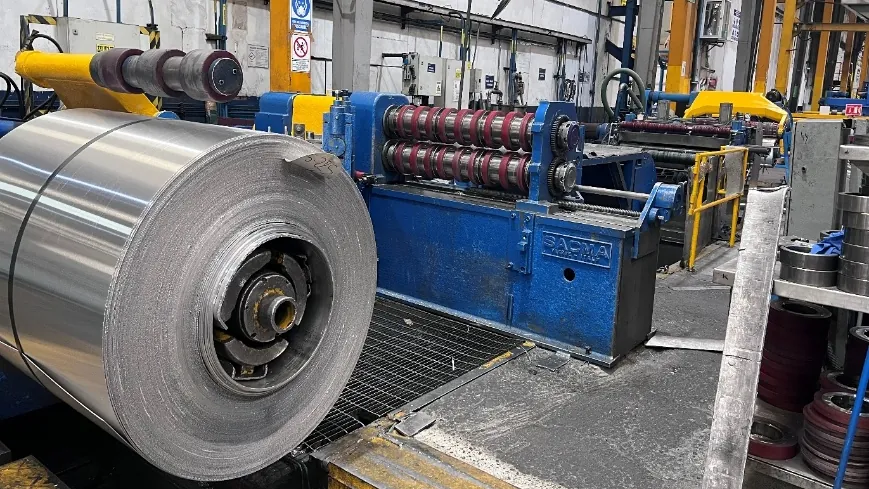
Buying flat-rolled aluminum for a process takes six steps: specify (alloy and temper with Aluminum Association designations, thickness in inches or millimeters, width or diameter, product form and tolerances, which are set by ANSI H35.2, 2024 edition), quote with the complete spec, decide packaging with whoever unloads, receive by matching tag, mill test report and purchase order, store indoors and dry, and claim with the lot number, photos and the material held unprocessed. What is not written on the purchase order is hard to claim. Almexa makes to order, answers a quote within 24 hours (up to 72 if it needs plant analysis) and ships a mill test report with every lot. Sources: The Aluminum Association, 2024 and 2009; ASTM B209; almexa.com.mx, October 2026.
This guide is for whoever buys aluminum to feed a press, a roll former, a spinning lathe or a paint line: purchasing, quality or engineering. It puts in one path what other guides on our blog already explain, without repeating them, and adds what was missing: how to write the spec, what to decide before quoting and how to build a claim.
Step 1. The spec: six items you cannot leave out
| Item | How to write it | Guide |
|---|---|---|
| Alloy | The registered four-digit number, for example 3003, not "3000 series" | What aluminum alloy numbers mean |
| Temper | Letter and digits, for example O, H14 or H32 | Temper guide |
| Thickness | In inches or millimeters, not gauge | Gauge chart |
| Width, diameter or length | The size that feeds your line | Coil widths |
| Product form | Coil, sheet, circle, blank or strip; for coil, the inside diameter | Products |
| Standard and tolerances | The standard with its edition and, if needed, special tolerances in writing | Below |
Alloy and temper designations follow the Aluminum Association's system, published as ANSI H35.1; ASTM B209, the US specification for sheet and plate, uses it to name them. Dimensional tolerances are in ANSI H35.2, "Dimensional Tolerances for Aluminum Mill Products," whose current edition is from 2024 and covers sheet and plate among other products; its tables are also in Aluminum Standards and Data 2024 (The Aluminum Association, October 28, 2024).
If your part needs a tighter tolerance than the standard, it goes on the purchase order, not in a phone call.
Always add what the part is for: with the end use, the mill can propose the temper or alloy that runs best in your process.
Step 2. Request the quote with everything in it
For a quote you can compare, send alloy and temper, thickness, width or diameter, product form, tons per order and per month, end use, delivery point and the documents you need with each lot, such as the certificate type or origin documentation.
When comparing suppliers, compare like with like: same tolerance, same delivery point, same documents. Sheet price is built from the LME, the regional premium and the mill's conversion charge (how aluminum price is calculated); in the US the premium is the Midwest premium (Midwest premium explained). If a quote looks cheap, check which of the three parts is missing or which LME date it used.
Step 3. Packaging: decide it with whoever unloads
Before quoting, ask your warehouse:
- What unloads and mounts the coil: forklift, crane, C-hook or coil ram?
- Does the uncoiler take the coil eye horizontal, or is it flipped in the plant?
- What is the heaviest load your equipment moves?
- Is the surface critical, for paint, anodizing or polishing? Then ask for interleaving and protection.
Almexa ships coil on export-type pallets, eye to sky (vertical) or eye horizontal, with a 20 in (508 mm) inside diameter, and circles in 55 lb (25 kg) bundles within Mexico or on export-type pallets up to 1,764 lb (800 kg). How material is loaded and secured, and why water stains appear, is in how to ship aluminum coil, sheet and circles without damage.
Step 4. Receiving: the material first, then the paperwork
- The truck: inspect packaging and skids before signing and note any damage or moisture on the receiving papers (The Aluminum Association, TR3, 2009).
- The temperature: if the metal arrives cold, compare it with your building's dew point before bringing it in; if it is below, let it warm up unopened.
- The tag against the purchase order: alloy, temper, dimensions, weight and lot number.
- The mill test report against the tag and the standard: same lot, measured values within limits. Field by field in how to read an aluminum mill test report.
- The dimensions: thickness with a micrometer at several points against the agreed tolerance, as in how to tell if aluminum is good quality.
Step 5. Storage until it reaches the line
From the Aluminum Association's TR3 guide (May 2009):
- Indoors, in a dry, ventilated area, with outside doors closed so temperature and humidity vary as little as possible.
- Never outdoors, packaged or bare, unless water stain does not matter for the end use.
- Away from cold walls, doors and windows if there are no fans to distribute heat.
- Packaging left intact until use and repaired if torn. If moisture condenses on the wrap, remove the moisture, not the wrap.
- For surface-critical products, preferably an air-conditioned warehouse with limited access; otherwise, inspect packages periodically.
- Rotate stock as quickly as possible.
- Between two areas more than 20°F (11°C) apart, move only what will be used right away.
Step 6. When something goes wrong: building the claim
- Hold the material unprocessed. Once slit, drawn or painted, a lot is harder to claim.
- Identify the lot from the tag and the mill test report.
- Measure the defect against what was agreed: the tolerance, the limit in the standard or the temper on the purchase order. "It runs badly" cannot be checked; "we measured 0.036 in on a coil ordered at 0.040 in" can.
- Take photos of the tag, the packaging and the defect, and keep samples.
- Notify in writing. The supplier always; if it is transit damage, the carrier too, within its time limit. For US interstate trucking, carriers cannot set less than 9 months to file a claim (49 U.S.C. 14706); for ocean cargo, hidden damage must be noticed within three days (COGSA). More in 10 things to know before shipping aluminum by ocean.
TR3 asks that any evidence of improper shipping, damaged packaging or water stain be reviewed with the metal producer: whoever made the lot is best placed to say what happened.
What to put on the purchase order
- Exact alloy and temper, dimensions and tolerances, with the standard and its edition.
- Product form, coil inside diameter, packaging and eye orientation.
- A mill test report per lot and, if needed, the EN 10204 document type or origin documentation, including country of smelt and cast for US entries.
- Delivery point and terms of sale.
The full list of documents per lot is in the mill test report guide.
How Almexa works
Almexa casts, rolls and slits in Cuautitlán Izcalli, State of Mexico, and makes to order: every coil, sheet or circle is rolled and cut for your order. It rolls 0.0177 to 0.148 in (0.45 to 3.76 mm), from 0.0197 in (0.50 mm) in the 5000 series, up to 48 in (1,219 mm) wide in the 1000 and 3000 series and 36 in (914 mm) in the 5000 series; tempers O, H12, H14, H16 and H18 in 1050, 1100 and 1350; O, H1X and H2X in 3003 and 3105; and O, H32, H34 and H36 in 3004, 5005, 5052 and 5754. It follows ASTM B209, with tolerances and flatness to Aluminum Association standards; special tolerances or flatness are validated with your sales rep before quoting. It answers a quote within 24 hours, or up to 72 if it needs plant analysis, and every lot ships with a mill test report. See coil, sheet and plate and circles.
Send your specification for a quote from the mill: alloy, temper, dimensions, tons and what the part is for.
Sources
All accessed October 27, 2026.
- The Aluminum Association, ANSI H35.2, "Dimensional Tolerances for Aluminum Mill Products," 2024: dimensional tolerances.
- The Aluminum Association, "Aluminum Association Releases 2024 Edition of Aluminum Standards & Data," October 28, 2024: H35.1 and H35.2 editions.
- ASTM, B209/B209M-21a: scope and designations per ANSI H35.1.
- The Aluminum Association, TR3, fifth edition, May 2009: receiving, storage and communication with the producer.
- 49 U.S.C. 14706, Carmack Amendment (LII) and Carriage of Goods by Sea Act (LII, note to 46 U.S.C. 30701): claim periods.
- Almexa data sheet and buying aluminum questions, October 2026: sizes, tempers, packaging, tolerances and quote response time.
Frequently asked questions
How do you specify aluminum sheet or coil?
With six items: the alloy's four-digit number, the temper, thickness in inches or millimeters, width, diameter or length, product form (coil, sheet, circle, blank or strip, plus inside diameter for coil) and the standard with its edition, plus any special tolerances in writing. Add what the part is for.
Which standard sets aluminum sheet tolerances?
ANSI H35.2, "Dimensional Tolerances for Aluminum Mill Products," published by the Aluminum Association, current edition 2024; its tables also appear in Aluminum Standards and Data 2024. If your part needs a tighter tolerance, agree it and write it on the purchase order.
What should an aluminum purchase order include?
Exact alloy and temper, dimensions and tolerances with the standard and its edition, product form and coil inside diameter, packaging and eye orientation, a mill test report per lot and, if needed, the EN 10204 document type or origin documentation, delivery point and terms of sale.
How should aluminum sheet and coil be stored?
Indoors, in a dry, ventilated area with doors closed, away from cold walls, doors and windows, with the packaging intact until use. The Aluminum Association recommends never storing it outdoors, even packaged, and rotating stock as quickly as possible.
How do I file a claim on a bad aluminum lot?
Hold the material unprocessed, identify the lot from the tag and the mill test report, measure the defect against the agreed tolerance, the standard's limit or the ordered temper, take photos and keep samples, and notify the supplier in writing; for transit damage, notify the carrier too, within its time limit.
What sizes and tempers does Almexa make?
Coil from 0.0177 to 0.148 in (0.45 to 3.76 mm), from 0.0197 in in the 5000 series, up to 48 in wide in the 1000 and 3000 series and 36 in in the 5000 series. Tempers O, H12, H14, H16 and H18 in 1050, 1100 and 1350; O, H1X and H2X in 3003 and 3105; and O, H32, H34 and H36 in 3004, 5005, 5052 and 5754.

Leads Almexa Aluminio, Mexico's aluminum rolling mill. Writes about alloys, process, pricing and supply for industrial buyers in North America. LinkedIn