
Blog · Sourcing
How to ship aluminum coil, sheet and circles without damage: trucking, securement and water stains

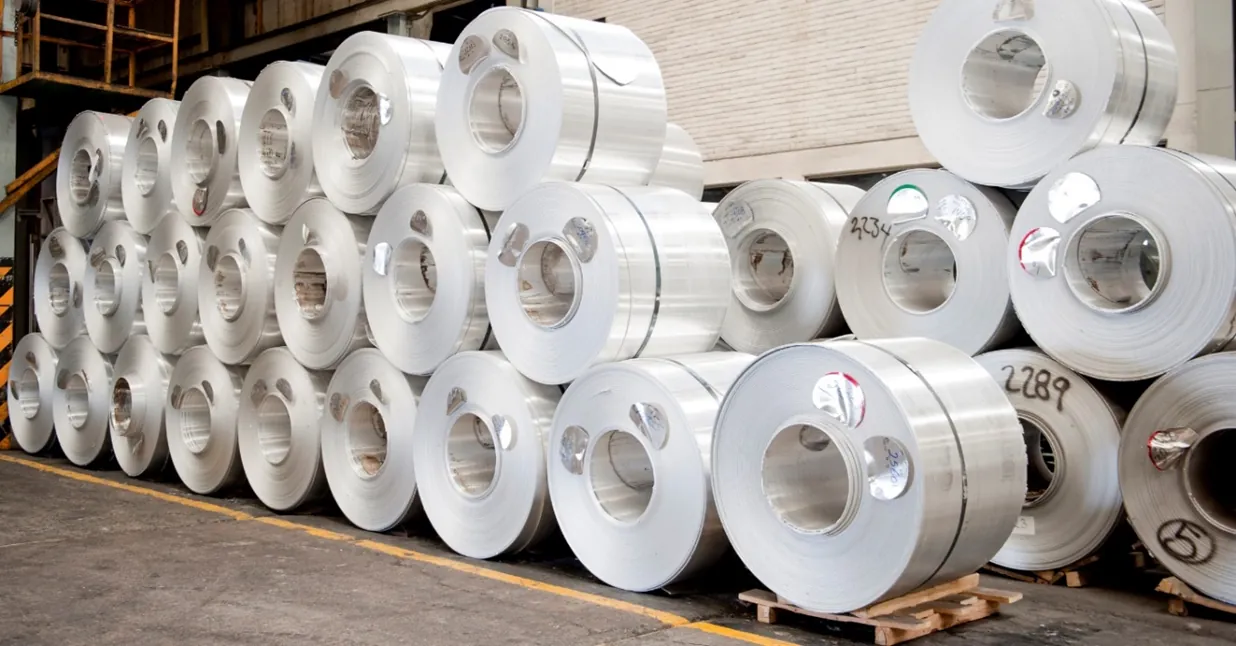
Flat-rolled aluminum gets damaged in transit in two ways: impact and movement (crushed edges, out-of-round coils, scratched sheet) and water trapped between wraps or sheets, which leaves water stains. Most stains are not caused by rain but by condensation: water forms when the metal is colder than the dew point of the air. The Aluminum Association's example: metal that traveled at 30°F (-1°C) and is moved into a 60°F (16°C) warehouse at 50% relative humidity, where the dew point is 41°F (5°C), gets wet. To prevent it: closed or insulated trailers, or flatbeds under tarps with no holes; every coil secured to its skid; packaging left closed; and cold metal left to warm up unopened for about a day before it goes into a heated building. Under FMCSA rules, coils of 5,000 lb (2,268 kg) or more have their own securement requirements by eye orientation. Almexa ships coil on export-type pallets, eye to sky or eye horizontal, and circles in 55 lb (25 kg) bundles or on pallets up to 1,764 lb (800 kg). Sources: The Aluminum Association, TR3, 2009; FMCSA, 49 CFR 393.120; Almexa data sheet, October 2026.
A coil can leave the mill in perfect shape and reach your dock with crushed edges or white stains between the wraps. It almost always happened on the road or in storage: the Aluminum Association says virtually all staining problems occur during shipping, handling or storage (TR3, 2009). This guide covers how flat-rolled aluminum is loaded, secured and received so it arrives the way it shipped.
What happens to aluminum in transit
| Damage | What it looks like | Common cause |
|---|---|---|
| Water stain | White, gray or iridescent patches between wraps or sheets | Water trapped with no airflow: rain, a torn tarp or condensation |
| Edge damage | Crushed or bent coil edge | Impact during loading or unloading, tiedowns bearing directly on the edge |
| Out-of-round or telescoped coil | Coil loses its round shape or wraps shift sideways | Excess pressure or a poorly secured coil |
| Scratches | Lines on sheet or circle faces | Sheets or circles moving against each other with no interleaving |
TT Club, the transport mutual insurer, advises securing coils so they do not telescope, packing them so they are not flattened into an oval, and protecting aluminum from scratching and from conditions that cause corrosion (StopLoss, 2010). Water stain has no significant effect on strength, but it can cause problems where the part will be finished or processed further (TR3). On sheet headed for paint or anodizing, or circles that will be polished, a stain can be grounds for rejection.
Water stain on aluminum: why it shows up when it did not rain
Aluminum stains when water is trapped between wraps, sheets or other mating surfaces with no airflow to remove it; prolonged contact causes the reaction that leaves the stain (TR3). Water gets there in two ways:
- External sources: rain, snow or leaks, such as a tarp with holes or a leaking warehouse roof.
- Condensation: water vapor condenses on the metal when the metal's temperature drops below the dew point of the surrounding air, the same way glasses fog up when you walk into a warm room. It is the harder of the two to control.
Two examples from the TR3 dew point chart:
| Warehouse air | Dew point | Metal below this gets wet |
|---|---|---|
| 60°F (16°C) at 50% RH | 41°F (5°C) | 41°F (5°C) |
| 55°F (13°C) at 60% RH | 40°F (4°C) | 40°F (4°C) |
Condensation tends to happen at three points (TR3):
- In storage, with doors left open in spring or fall: cold night air cools the metal, and in the morning the air warms up and its dew point rises faster than the metal can follow.
- At loading, when metal from a cool warehouse goes into a warm trailer on a humid day.
- At unloading, when cold metal goes straight into a warm building. In the TR3 example, metal at 60°F rides two days in 30°F weather, arrives at 30°F and is moved into a 60°F warehouse at 50% RH; the dew point is 41°F, so water condenses on the edges and wicks between sheets and wraps.
People also search for "white rust" on aluminum. Strictly, white rust and wet storage stain are terms for zinc corrosion on galvanized steel (American Galvanizers Association); on aluminum the industry term is water stain.
Most water stains do not come from rain: they come from moving cold metal into warm, humid air.
Trucking: van, insulated trailer or tarped flatbed
The Aluminum Association's TR3 recommends:
- For surface-critical products, insulated trucks or rail cars to minimize day and night temperature cycling; in winter, insulated or heated trailers whenever possible.
- On a flatbed, the load completely covered with a high-integrity tarp, with the deck and tarp dry before loading.
- The carrier should re-tarp the truck after each intermediate delivery.
- Minimize long layovers at truck and rail terminals.
- For critical products, a portable temperature and humidity recorder in the load, so the risk of water stain can be assessed at receiving.
An uninsulated dry van keeps rain off but not condensation: in the TR3 example, the metal cooled down over two days in transit.
Coil: eye to sky or eye horizontal
The eye is the coil's center opening. There are two ways to ship it:
- Eye to sky (eye vertical): the coil lies on one face on the skid. It handles with a forklift and sits stable. In ocean containers it is used only for small, narrow coils such as slit coils (GDV, Container Handbook).
- Eye horizontal: the coil stands on a cradle or a skid with chocks that keep it from rolling. It is how most uncoilers take it, lifted with a C-hook or a coil ram through the eye.
Pick the one your dock can unload and your line can mount most easily. Almexa ships coil on export-type pallets, eye to sky or eye horizontal, with a 20 in (508 mm) inside diameter; tell us which in the quote request.
How coils are secured on a truck: 49 CFR 393.120
In the United States, FMCSA's rule for metal coils applies to coils weighing 5,000 lb (2,268 kg) or more, individually or grouped:
| Eye orientation | What the rule requires for an individual coil |
|---|---|
| Vertical, eye to sky | A diagonal tiedown on each side crossing over the eye, a transverse tiedown over the eye, and blocking, friction mats or tiedowns against forward movement |
| Crosswise, axis across the deck | Timbers, chocks, wedges or a cradle that prevent rolling and support the coil off the deck, held so they cannot work loose; one tiedown through the eye against forward movement and one against rearward movement, where practical at no more than 45 degrees to the deck. Tiedowns crossed in an X through the eye are prohibited |
| Lengthwise, axis along the trailer | The same rolling prevention, plus one of three tiedown and blocking combinations |
The aggregate working load limit of the tiedowns must also be at least one-half the weight of the cargo they secure (49 CFR 393.106). In Canada, National Safety Code Standard 10 has its own section on coils transported with eyes crosswise, with the same off-the-deck support and one tiedown through the eye in each direction (CCMTA, section 50, as revised in June 2013).
Two more points: the coil must be strapped tight to its skid and the skid secured to the trailer so nothing shifts and tears the packaging (TR3), and steel strapping should not run over timber edges without edge protectors, because it can slacken (GDV).
Sheet and circles: skids, packaging and interleaving
- Packaging: papers, plastic films or laminates that resist moisture. Shrink wrap should envelop the whole package so any condensation runs off instead of getting in (TR3).
- Interleaving: for surface-critical sheet and plate, special paper, foam sheets or other material between sheets against abrasion (TR3).
- Attachment: the package securely attached to the skid; if it moves, it tears the packaging (TR3).
- Desiccants inside the package: TR3 does not recommend them, because on long routes they overload quickly and a cold surface can collect a large amount of moisture.
Almexa ships circles in 55 lb (25 kg) bundles within Mexico or on export-type pallets up to 1,764 lb (800 kg). For sheet, specify the packaging you need in your quote request: skids, interleaving and protection.
What to check when the truck arrives
TR3 points out that carrier claims normally have a time limit, which is why inspection happens at unloading. For interstate truck shipments in the US, the Carmack Amendment does not let carriers set less than 9 months to file a claim or less than 2 years to sue, with the 2 years counted from the carrier's written notice that it disallowed the claim (49 U.S.C. 14706(e)); your bill of lading sets the actual terms.
- Before signing, inspect skids, packaging and tarps. If there is water, wet or puckered paper or torn packaging, note it on every copy of the receiving papers and take photos.
- Feel the metal. If it is cold, take the temperature of a few coils with a probe or contact thermometer; if you cut a 6 x 6 in flap in the wrap to measure, tape it back. Compare with the dew point of your building from a temperature and humidity meter. Do not use mercury thermometers: mercury from a broken one corrodes aluminum (TR3).
- If the metal is below the dew point, do not move it into warm storage. Leave it unopened in a cooler indoor area away from drafts, check it every few hours and move it once it has warmed up, about a day later.
- Between two areas more than 20°F (11°C) apart, move only what you will use right away.
- If it arrives wet, tell purchasing or quality and the supplier. The only sure fix is to process it immediately and dry it as it is used; a coil can be unpackaged, laid on its side and dried with fans, hot air if possible (TR3).
- Match the lot on the tag with the mill test report, as explained in how to read an aluminum mill test report.
Signing a clean delivery receipt over damaged packaging is the fastest way to lose a claim.
Storage until it reaches your line
Indoors, dry and ventilated, doors closed, never outdoors even when packaged, away from cold walls, doors and windows, and with the packaging intact until use (TR3). More detail, plus what to put on the purchase order, in our guide from spec to receiving.
How Almexa packs
Almexa casts, rolls and slits at its plant in Cuautitlán Izcalli, State of Mexico, and ships by truck to the United States and Canada. Coil ships on export-type pallets, eye to sky or eye horizontal, with a 20 in (508 mm) inside diameter; circles ship in 55 lb (25 kg) bundles within Mexico or on export-type pallets up to 1,764 lb (800 kg). Every lot comes with a mill test report. If material moves by sea, also read 10 things to know before shipping aluminum by ocean.
Send your specification for a quote from the mill: alloy, temper, dimensions, tons, eye orientation and how you unload.
Sources
All accessed October 27, 2026.
- The Aluminum Association, "Guidelines for Minimizing Water Staining of Aluminum," TR3, fifth edition, May 2009: causes, dew point, packaging, shipping, receiving and storage.
- FMCSA, 49 CFR 393.120, securing metal coils (eCFR) and 49 CFR 393.106: securement by eye orientation and aggregate working load limit.
- CCMTA, National Safety Code Standard 10, changes approved June 2013: section 50, coils with eyes crosswise.
- 49 U.S.C. 14706, Carmack Amendment (LII): minimum periods for claims and lawsuits.
- GDV, Container Handbook, "Eye to sky" and coils on skids, horizontal winding axis: eye orientation and strapping over timber edges.
- TT Club, "StopLoss: transport of coiled materials," 2010: telescoping, ovalizing and protecting aluminum.
- American Galvanizers Association, "Wet Storage Stain": white rust and wet storage stain on galvanized steel.
- Almexa data sheet, October 2026: coil and circle packaging.
Frequently asked questions
How do you ship an aluminum coil?
On a skid or cradle, strapped tight to it, with the skid secured to the trailer, in a closed or insulated trailer or on a flatbed under a tarp with no holes. The eye can ship to the sky, with the coil lying flat, or horizontal, with chocks or a cradle that keep it from rolling. In the US, coils of 5,000 lb or more follow 49 CFR 393.120, which sets tiedowns by eye orientation.
What is water stain on aluminum?
It is white, gray or iridescent staining that forms when water is trapped between wraps or sheets with no airflow to dry it. The Aluminum Association's TR3 guide says it has no significant effect on strength but can cause problems where the part will be finished or processed further. The guide focuses on preventing it and removing the water before it stains.
Is white rust on aluminum the same as water stain?
Not exactly. White rust and wet storage stain are terms for zinc corrosion on galvanized steel, according to the American Galvanizers Association. On aluminum, the industry term is water stain, and it comes from water trapped between wraps or sheets, very often from condensation.
Why does condensation form on aluminum coils?
Because the metal is colder than the dew point of the air. In the Aluminum Association's example, aluminum that traveled at 30°F and is moved into a 60°F warehouse at 50% relative humidity, where the dew point is 41°F, gets wet on the edges, and the water wicks between sheets and wraps.
Eye to sky or eye horizontal: which is better for coil?
Whichever your dock can unload and your line can mount most easily. Eye to sky lies flat on the skid and handles with a forklift; eye horizontal stands on a cradle or chocks and is lifted through the eye onto the uncoiler. Almexa ships both on export-type pallets.
What should I do if a coil arrives cold or wet?
If it is cold, do not move it into a warm building: leave it unopened in a cooler indoor area away from drafts for about a day. If it is wet, note it on the receiving papers, notify the supplier and process it immediately, or unpack it, lay it on its side and dry it with fans, as the Aluminum Association recommends.

Leads Almexa Aluminio, Mexico's aluminum rolling mill. Writes about alloys, process, pricing and supply for industrial buyers in North America. LinkedIn