
Blog · Specification
Aluminum blanks: when to buy cut-to-size blanks instead of coil or sheet, and how to specify them

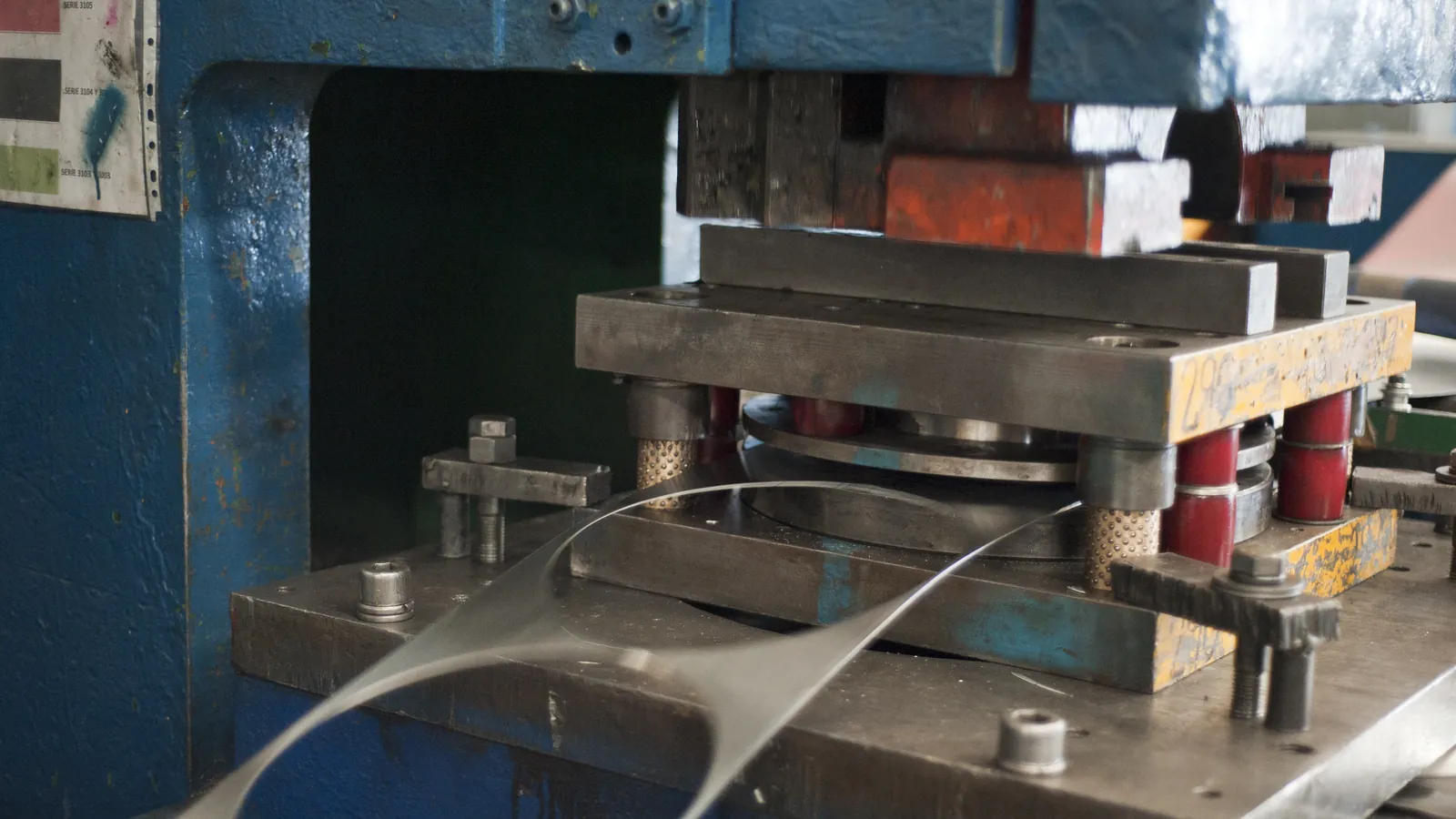
An aluminum blank is a flat piece already cut to the shape and size your press takes: square, rectangular or to your drawing. A circle is a round blank; sheet is a standard rectangle you still have to cut. Blanks make sense when your press has no coil feed line, when shearing sheet in-house leaves too much scrap, or when you want to receive only the parts you use. They are cut on a shear (straight shapes) or in a press with a blanking die (any shape); what you check is burr, flatness, dimensions and temper, and deep drawing calls for O temper. Almexa cuts blanks from its own coil in the 1000, 3000 and 5000 series, within the coil gauge range (0.0177 to 0.148 in, 0.45 to 3.76 mm), with 10 stamping presses; sizes, minimums and tolerances are confirmed against your drawing on the quote. Sources: Almexa data sheet, October 2026; Transactions of FAMENA, 2017.
In a stamping plant, the blank is the flat piece that goes into the press. Buyers call them close tolerance blanks when the size is tight; in French, flans; in Mexico, blanks too. This guide explains when to buy them already cut and how to specify them so they arrive ready for your die.
Blank, circle, sheet and strip: the difference
| Form | What it is | Who cuts it to final shape |
|---|---|---|
| Sheet | Standard-size rectangle | You, on a shear or press |
| Strip (slit coil) | Narrow coil, one continuous strand | Your press, with a coil feed line |
| Circle | Round blank, for drawing or spinning | The mill |
| Blank | Flat piece to your drawing: square, rectangular or other | The mill |
A circle is one kind of blank. For round parts, alloy, temper and size are covered in aluminum circles for spinning and which aluminum alloy for deep drawing.
When blanks beat coil or sheet
- Your press has no coil feed line. Without an uncoiler, straightener and feeder, the press runs part by part, and a blank arrives ready to load.
- Shearing sheet in-house leaves too much scrap. A 48 x 96 in sheet yields 32 blanks of 12 x 12 in (4 by 8) with no drop, but only 18 blanks of 14 x 14 in (3 by 6), using 77% of the sheet. Buying blanks moves the cutting plan to the mill, which starts from its own coil width.
- Your part is not rectangular. Trapezoids, L shapes or clipped corners can be nested, alternating along the strip, to use more metal. A circle in its square uses at most π/4, 78.5%; in staggered rows the theoretical maximum rises to 90.7%.
- You run many shapes in small lots. You receive parts instead of stocking coil or sheet for each one.
When comparing, compare per usable part or per pound of part, not just per pound of metal: with blanks, cutting and its scrap move to the supplier.
When blanks do not pay: at high volume with a progressive die and a feed line, running slit coil cut to your width is usually simpler.
How blanks are cut
- On a shear. Straight cuts for squares and rectangles: lengthwise first, then crosswise. The route for simple shapes and sizes that change often.
- With a blanking die in a press. Punch and die cut the full shape in one stroke, with holes if needed. It handles any geometry and repeats the size part after part; the die is built to your drawing.
The die sets the shape; punch to die clearance and sharpness set the edge.
Burr, flatness and dimensions
Burr. The lip of metal the cut leaves behind. In a study on 0.04 and 0.08 in (1 and 2 mm) 5754 aluminum with clearances of 8% to 18% of thickness, burr grew as clearance opened, and clearance explained 76% of burr formation against 23% for thickness (Çavuşoğlu and Gürün, Transactions of FAMENA, 2017). Specify the maximum burr height and the side: in deep drawing it matters whether it faces the punch or the die.
Flatness. A blank that does not sit flat in the die wrinkles or marks. At Almexa, flatness for each product follows Aluminum Association standards; if your part needs special flatness, it is validated with your sales rep before quoting.
Dimensions. Blank tolerance depends on geometry and gauge. Almexa's for blanks are confirmed against your drawing on the quote; if your die or robot needs a tight size, write it on the RFQ.
Rolling direction. If the part is bent or drawn, mark the rolling direction on the drawing: the metal does not behave the same along and across the roll.
Which temper to order
- Deep drawing: O temper, annealed, the softest. Why, and with which alloy, in deep drawing.
- Stamping with gentle bends, or a flat part that must be stiff: a strain-hardened temper such as H14 or H32.
- Torn between two: send the next process and the tightest bend radius; the temper is proposed from that.
What O, H14 and H32 mean is in aluminum temper designations. At Almexa: O, H12, H14, H16 and H18 in 1050 and 1100; O, H1X and H2X in 3003 and 3105; and O, H32, H34 and H36 in 3004, 5005, 5052 and 5754.
What to put on the RFQ
- Drawing with dimensions, corner radii, holes and tolerances, as PDF or DXF.
- Alloy and temper, or the next process: drawing, bending or flat stamping.
- Gauge and its tolerance.
- Maximum burr height and side, and flatness if special.
- Rolling direction relative to the drawing.
- Parts per month and per release.
- Packaging: parts per bundle, interleaving if the surface is critical, maximum skid weight.
- Mill test report per lot.
How to inspect blanks at receiving
- Tag and count against the PO.
- Dimensions with calipers: length, width and, on rectangular blanks, both diagonals; if they differ, the blank is out of square.
- Gauge with a micrometer.
- Burr on every edge.
- Flatness: blank on a flat table, largest gap measured with feeler gauges.
- Surface: scratches, marks or water stain. Why they appear is in how to ship aluminum coil, sheet and circles.
- Press trial: run a few parts before releasing the lot.
How Almexa works
Almexa cuts blanks from coil it casts and rolls in Cuautitlán Izcalli, State of Mexico: square, rectangular or to your drawing, in 1050, 1100, 3003, 3004, 3104, 3105, 5005, 5052 and 5754, within the coil gauge range of 0.0177 to 0.148 in (0.45 to 3.76 mm; from 0.0197 in, 0.50 mm, in the 5000 series). It has 10 stamping presses. Sizes, minimum blank size and tolerances depend on geometry and gauge and are confirmed against your drawing on the quote; every lot ships with a mill test report. See aluminum blanks and, for round parts, aluminum circles, 6.30 to 47.24 in (160 to 1,200 mm) in diameter in the 1000 and 3000 series.
Send your specification for a quote from the mill: drawing, alloy, temper, gauge and parts per month.
Sources
All accessed October 28, 2026.
- Çavuşoğlu and Gürün, "The Relationship of Burr Height and Blanking Force with Clearance in the Blanking Process of AA5754 Aluminium Alloy," Transactions of FAMENA, vol. 41, no. 1, 2017: clearance and burr.
- The Aluminum Association, ANSI H35.2, "Dimensional Tolerances for Aluminum Mill Products," 2024: tolerance standard.
- Almexa data sheet and aluminum blanks page, October 2026: alloys, gauges, tempers, presses and flatness.
- Sheet and circle yield: our own calculation with simple geometry.
Frequently asked questions
What is an aluminum blank?
It is a flat aluminum piece already cut to the shape and size your press takes: square, rectangular or to your drawing, ready to stamp, draw or form. Close tolerance blanks are blanks held to a tight size.
What is the difference between an aluminum blank, a circle and sheet?
A circle is a round blank. A blank is any flat piece cut to the shape of the part. Sheet is a standard-size rectangle you still have to cut in your own plant.
When should I buy blanks instead of coil or sheet?
When your press has no coil feed line, when shearing sheet in-house leaves too much scrap, when the part is not rectangular and nests better, or when you run many shapes in small lots.
What temper should aluminum blanks be for deep drawing?
O temper, annealed. For flat parts or gentle bends that need stiffness, a strain-hardened temper such as H14 or H32. If unsure, send the next process and the tightest bend radius.
What causes burr on aluminum blanks?
Mainly punch to die clearance and die sharpness. In a study on 1 and 2 mm 5754 aluminum, clearance explained 76% of burr formation and thickness 23% (Transactions of FAMENA, 2017).
What do I need to quote custom aluminum blanks?
The drawing with dimensions and tolerances, alloy and temper or the next process, gauge, the burr and flatness you accept, rolling direction if it matters, and parts per month.
What blanks does Almexa make?
Square, rectangular or to-drawing blanks cut from its own coil in the 1000, 3000 and 5000 series, 0.0177 to 0.148 in (0.45 to 3.76 mm) thick, with 10 stamping presses. Sizes, minimums and tolerances are confirmed against your drawing on the quote.

Leads Almexa Aluminio, Mexico's aluminum rolling mill. Writes about alloys, process, pricing and supply for industrial buyers in North America. LinkedIn