
Blog · Sourcing
Aluminum Manufacturers in Mexico: Mill, Extruder or Distributor?

Mexico does not produce primary aluminum; it imports the ingot (IMEDAL, May 2024). Aluminum manufacturers in Mexico fall into five groups: secondary smelters and recyclers, rolling mills that melt, cast and roll coil, sheet and circles, extruders that make profiles, die casters that make parts, and distributors that cut and resell. The industry processes about 3 million metric tons a year (IMEDAL, cited by El Cronista, September 2026). For flat-rolled products, the mill is the one that controls alloy, temper and the lot's country of cast.
Nearshoring has US buyers searching for aluminum suppliers south of the border, and the results mix window makers, metal distributors and rolling mills under the same label. All of them sell aluminum, but only one can stand behind the alloy, the temper and the origin of the lot. This guide sorts aluminum manufacturers in Mexico by what they actually make, so you know which one to call.
Does Mexico produce primary aluminum?
No. Primary aluminum is smelted from alumina by electrolysis in power-hungry plants, and "Mexico does not produce primary aluminum," according to the Mexican Aluminum Institute (IMEDAL, May 2024). Primary ingot such as P1020 is imported and bought from traders. A Mexican aluminum manufacturer transforms metal; it does not smelt it from ore.
What Mexico does have is a large processing industry: about 3 million metric tons a year, roughly 1% of GDP and more than 30,000 direct jobs, according to IMEDAL (cited by El Cronista on September 18, 2026). Mexico still buys far more than it sells: in 2025 it imported US$10.571 billion of aluminum and aluminum goods and exported US$2.709 billion (Mexico's Ministry of Economy, same report).
Five kinds of aluminum manufacturers in Mexico
| Type | What it does | What it sells | Buy from it if... |
|---|---|---|---|
| Secondary smelter or recycler | Melts scrap and ingot and adjusts the alloy | Secondary ingot, billet, casting alloys | You run a foundry or an extrusion press |
| Rolling mill | Melts, casts slab and hot and cold rolls it | Coil, sheet, plate, circles, strip, hot band | You need flat-rolled product with a defined alloy and temper |
| Extruder | Pushes hot billet through a die | Profiles for windows, framing, rails, heat sinks | Your part has a constant cross section |
| Die caster | Pours or injects metal into molds | Auto parts, housings, finished parts | You buy the part, not the material |
| Distributor or service center | Buys coil from a mill or imports it, then cuts and resells | Cut sheet, slit strip, stock profiles | You need small lots fast from stock |
The word "manufacturer" tells you nothing about the link in the chain; what a supplier sells and can certify does.
Rolling mill: coil, sheet and circles
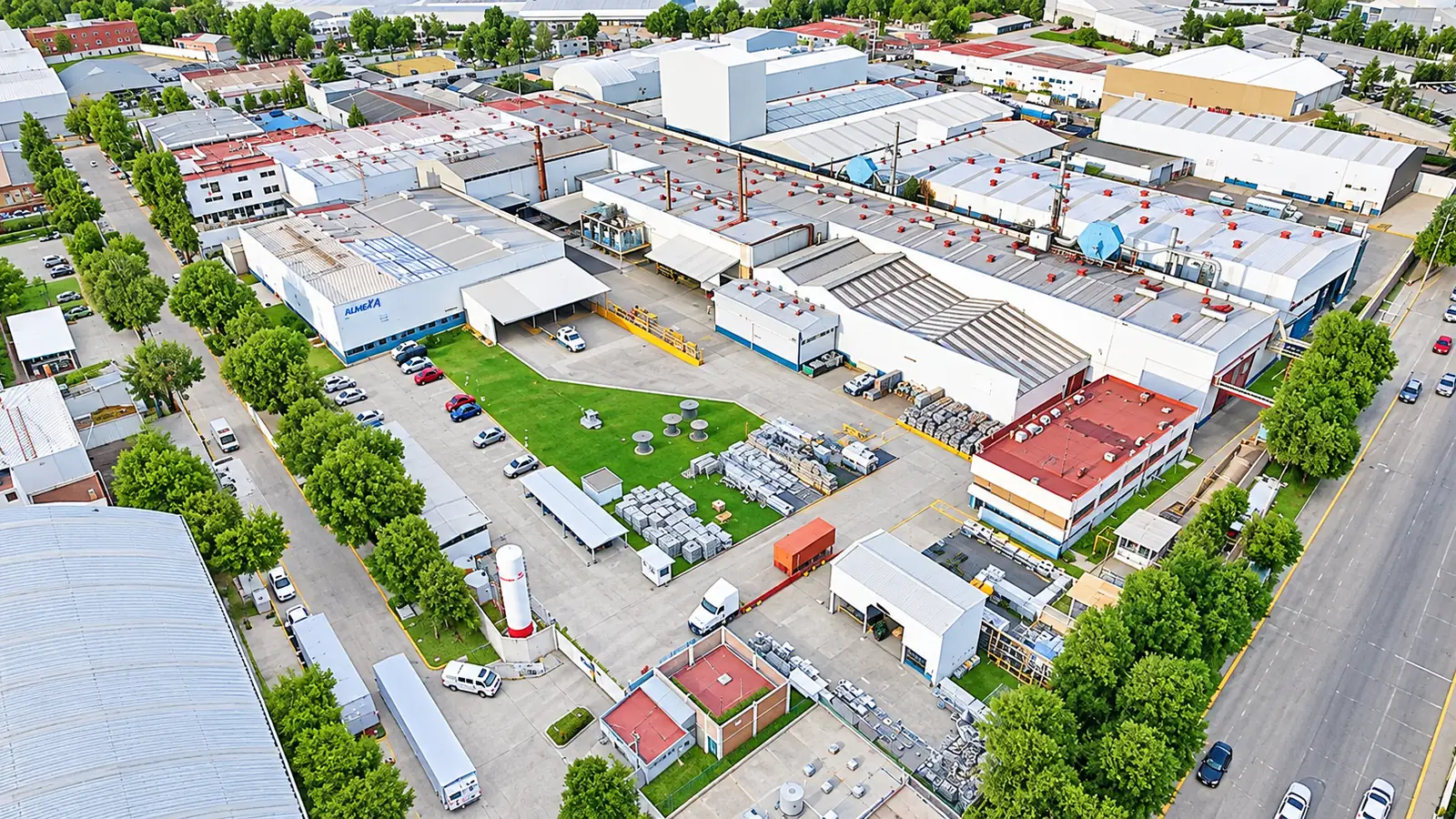
A rolling mill makes flat products from molten metal. At Almexa in Cuautitlán Izcalli, near Mexico City, the route runs from melting to direct-chill slab casting, scalping, preheating, hot and cold rolling, cutting and annealing; the full walk-through is in how flat-rolled aluminum is made. The plant has 20,000 metric tons a year of installed capacity (Almexa technical sheet, September 2026).
Because the mill sets the alloy in the furnace, it is the link that signs the lot's chemistry and temper on its own mill test report. That is why it sells by the ton, ships a certificate with every lot and can suggest a different alloy or width when your part allows it.
Extruder: profiles for windows and framing
An extruder does not roll anything. It heats a billet and pushes it through a die to get a bar with the profile's cross section: window frames, curtain walls, rails, heat sinks. If your part is a profile, that is your supplier. If it is a sheet, a lid or a pan, it is not.
How do you tell a distributor from a mill?
Plenty of websites say "manufacturer" and actually cut and resell coil from a mill or from overseas. That is not a problem in itself: a good distributor carries stock, cuts to size and delivers in days. What matters is which mill the metal came from, because that defines the origin and who answers if a lot fails.
Three signs you are talking to a distributor:
- It cannot tell you where the metal was cast.
- The mill test report carries another company's name.
- It cannot change alloy or temper, only sell what is in stock.
Buying from a distributor is about speed; buying from the mill is about specification and volume.
What should you ask an aluminum supplier in Mexico?
- Do you melt and roll, or do you buy coil and cut it?
- Where was the metal cast, and who signs the mill test report?
- Which alloys and tempers do you make, and in what gauge and width range?
- What is the lead time from the plant, and what is the minimum order?
- Which origin documents come with each lot? What US Customs and automakers ask for is in how to document the country of smelt and cast.
Which supplier fits your part?
- Coil, sheet, cookware circles, blanks or strip: a rolling mill. Check the ranges for aluminum coil and aluminum sheet and plate.
- Window or framing profiles: an extruder.
- A finished part such as a housing or an auto part: a die caster.
- A few sheets by tomorrow: a distributor with stock.
- Ingot for your own foundry: a secondary smelter.
If you need flat-rolled product, send your specification to the plant and a sales executive will reply with alloy, temper and a ship date.
Frequently asked questions
Does Mexico produce aluminum?
Mexico does not produce primary aluminum; the ingot is imported (IMEDAL, May 2024). The Mexican industry recycles, rolls, extrudes and casts parts, processing about 3 million metric tons a year according to IMEDAL.
What is the difference between rolled and extruded aluminum?
Rolled aluminum is flattened between rolls to final gauge and ships as coil, sheet or circles. Extruded aluminum is pushed through a die and ships as a profile with a constant cross section. Sheet is not extruded and profiles are not rolled.
Where can I buy aluminum coil directly from a mill in Mexico?
From a rolling mill that melts, casts and rolls the metal. Almexa does it in Cuautitlán Izcalli, State of Mexico, and sells coil, sheet, plate, circles, blanks, strip and hot band by the metric ton, with a mill test report for every lot.
How do I know if an aluminum supplier is a mill or a distributor?
Ask where the metal was cast and who signs the mill test report. If the report carries another company's name, or the supplier cannot change alloy or temper, it is a distributor.

Leads Almexa Aluminio, Mexico's aluminum rolling mill. Writes about alloys, process, pricing and supply for industrial buyers in North America. LinkedIn